

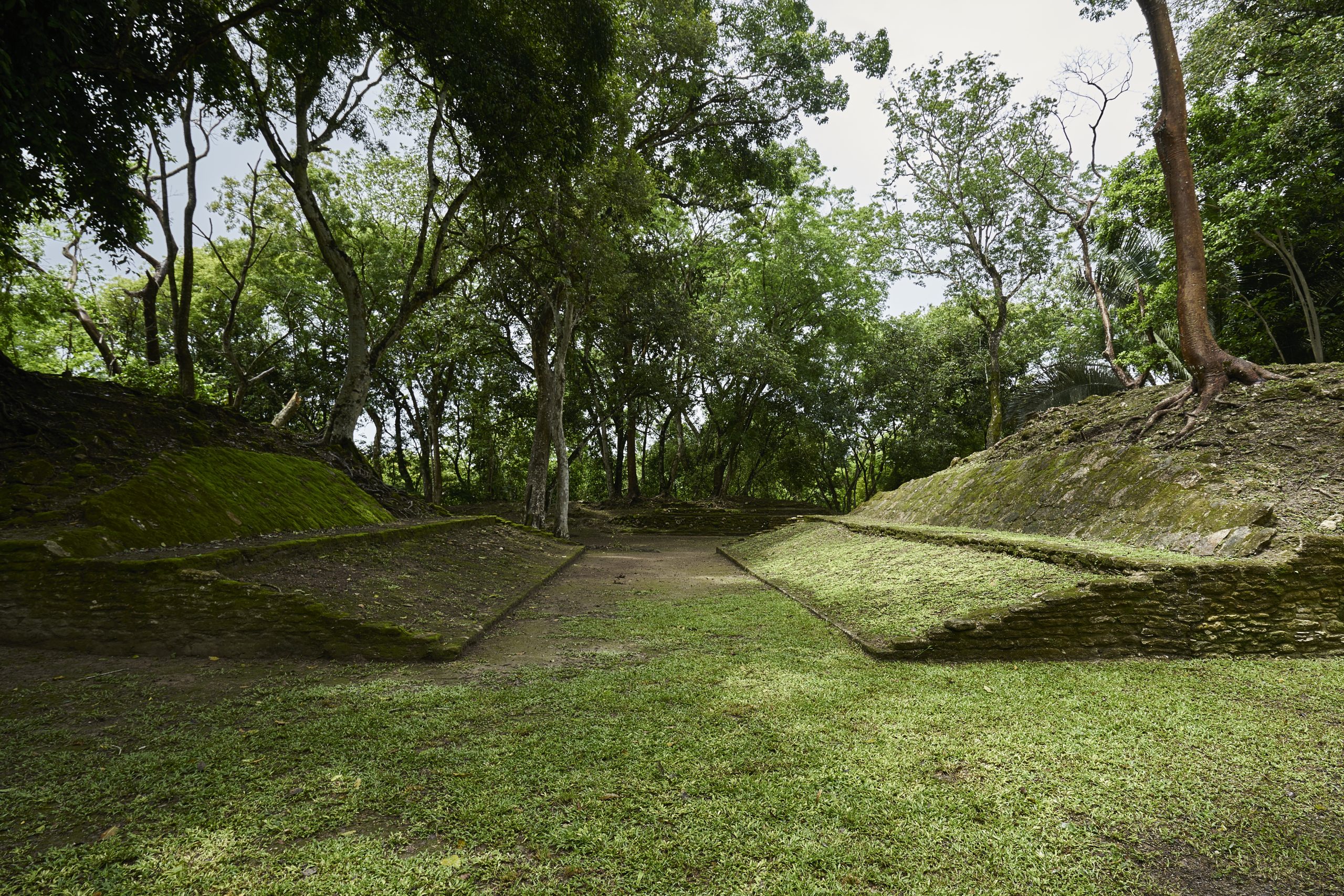
Football is regarded as the world’s most popular sport and is played by hundreds of millions of people across every continent. Nevertheless, its earliest origins remain unclear, and we do not know for certain to what extent the peoples of antiquity practised this sport in the form we know today, or in a similar form.
Early precursors are known for most modern sports, particularly in ancient civilisations that were already holding sporting competitions thousands of years ago. When examining archaeological finds, we come across an ancient game in Mesoamerica – a region stretching from southern Nicaragua to the north of what is now the US state of Arizona – known simply as the ‘ball game’. This was neither football nor handball, but a unique form of play involving a rubber ball, governed by its own very specific set of rules.
This game raises numerous questions: How did it originate? How was it played? And what role did it play in the lives of these ancient societies?
It is noteworthy that its significance extended far beyond mere entertainment and sporting competition, as it was closely linked to religious rituals and symbolic beliefs. Unlike modern sports, which end in victory or defeat, some matches of this ball game were a matter of life and death – a scenario reminiscent of the bloody spectacles in the ancient Roman amphitheatres.
The origins of the ball game in Central America 3,600 years ago
This game originated in the 16th century BC in the region that today comprises southern Mexico, Guatemala and most of Central America, where corresponding playing fields have been discovered. The civilisations that flourished at that time were characterised by a golden age of the arts, architecture and astronomy. Religious belief, however, was the most defining aspect of these cultures: there were huge temples in which numerous religious rituals, and sometimes even human sacrifices, were performed.
The priestly class formed the ruling and most influential group in society. It was a shared cultural system with many local variations. There was cultural exchange between the civilisations of Mesoamerica – such as the Olmec, the Maya and the Aztecs – which also extended to the ball game. At that time, the American continent was completely isolated from the rest of the world, as it had not yet been discovered by European or Asian cultures. Consequently, there was no cultural exchange with other civilisations.
The Paso de la Amada site is considered the oldest known ball court in Mesoamerica to date and is dated to around 1600 BC. The court is approximately 85 metres long and ranks among the largest and most significant complexes of its time. It is situated in the far south of present-day Mexico on the Pacific coast.
The geometric shape of the ball courts
The ball game was played on large structures built of stone. In Central America, more than 1,300 ball courts have been documented. These structures were built according to a standard design that remained virtually unchanged over a period of some 2,700 years. Around 60 per cent of these ball courts have only been discovered in the last twenty years.
Despite significant differences in size, all playing fields share a similar basic shape: a long, narrow playing area bounded by walls with horizontal and sloping surfaces (and, in rare cases, vertical walls). Whilst early playing fields were open at both ends, later complexes were closed at the ends, giving them – when viewed from above – the shape of an ‘I’.
Although the ratio of length to width averages around 4:1, there are considerable variations in the dimensions of the playing fields. The playing field at Chichén Itzá, measuring 96.5 metres in length and 30 metres in width, is considered the largest known, whilst the court at Tikal measures only around 16 by 5 metres.
At the centre: a bouncy rubber ball
The ball used in the game had a diameter of between 10 and 22 centimetres and weighed up to around 4 kilograms, although its size and weight varied over time or depending on the variant of the game and the category of players. It was made of hard rubber, and its bounce was the result of a process similar to the ‘vulcanisation of rubber’. This is similar to a process in which the sap of the rubber tree was mixed with ground-up material from other plants, giving it elastic properties and a bounce suitable for the game. To the first Spaniards who observed this game, the ball seemed ‘enchanted’, as they had never before seen an object with such bounce.
An acrobatic game with complex rules
The most important ancient sources on the Mesoamerican ball game are archaeological finds and early Spanish accounts. These include reliefs, murals and depictions in Maya and Aztec temples, which illustrate the game and its ritual significance. The ball courts in cities such as Chichén Itzá are particularly significant. In addition, 16th-century Spanish chroniclers provide valuable descriptions of the game and its religious aspects.
In most variants of the game, it was forbidden to touch the ball with the hands or feet. Instead – depending on regional rules – it could be played with the hips, shoulders or arms. In the most common variant, the ball was mainly played from one side to the other using the hips, with the aim of keeping it constantly in motion within the playing area. A team lost a point or the match if it was unable to return the ball or if the ball left the playing area.
The matches were played between two teams, each consisting of around two to four players. In many cases, the game was extremely physical and prone to injury, as the heavy, hard ball could cause serious harm.
According to the historian Toribio de Benavente Motolinia, who lived in the 16th century, a point was scored when the ball touched the opposite wall, whilst a definitive victory was only achieved by passing the ball through the stone ring. However, this feat was extremely rare, as the rings at Chichén Itzá were positioned high up and far from the playing field. Consequently, most matches were decided on points.
Religious rituals with cosmological significance
The ball game was far more than just a sporting activity. It played a significant religious and cultural role and was closely linked to the worldviews of Mesoamerican societies. In some cases, it symbolised the struggle between light and darkness or between life and death.
The major official games took place within a religious and festive context. The moving rubber ball was symbolically interpreted as representing the orbits of sacred celestial bodies such as the sun, the moon and Venus. It was believed that the winner of the game received the protection and support of the gods.
The main aim of the game was to keep the ball in constant motion. If the ball fell to the ground, this was regarded as a bad omen. Many historians assume that the ball was a symbol of the sun and that its movement across the playing field had profound cosmic and religious significance. At the same time, however, the game was also played informally as a leisure activity, including by children and, to some extent, by women.
Sport and leisure combined with religion and power
Ultimately, this game demonstrates that ancient civilisations were not only concerned with war, politics and religion, but also developed complex sporting and leisure activities, even if some of these were linked to religious beliefs and political power. The ball game in Central America is a unique example of the interconnection between sport, religious rituals and cosmological symbols.
Further information:
Mesoamerican ball game – Wikipedia
The ball game is still practised in some regions of Mexico, particularly at archaeological sites such as Tuitocán near Mexico City and Cancún in southern Mexico. Nowadays, however, the game is only played to pass on cultural traditions and for tourism purposes:
https://www.spiegel.de/video/mesoamerikanisches-ballspiel-in-teotihucan-in-mexiko-video-99017428.html
tun26062406