

In August 2025, tuenews employee Lobna Alhindi travelled to Syria. For the first time since fleeing eleven years ago, she visited her family in Al-Thaura in the north of the country. After such a long time, she was finally able to embrace her father, mother, brother, sisters, nieces and nephews again. “Being with my family healed my soul,” says Alhindi. And yet her old homeland has become foreign to her.
The journey to north-eastern Syria is long. There are still no direct flights from Germany to Syrian cities. Alhindi therefore decided to fly via Amman in Jordan. And she took not only her German passport with her, but also her Syrian one. She found the atmosphere at Damascus airport relaxed, in contrast to the waiting time during the stopover in Jordan. “The airport staff in Damascus were very nice, quite different from before,” she says. “That makes a difference; you’re not afraid anymore.”
“The air is very dirty”
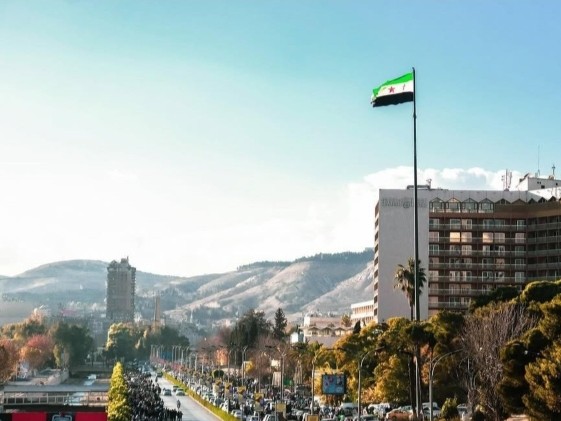
Her brother and his wife picked her up to drive to their family in Al-Thaura, more than five hours’ drive from Damascus. The city is located in the Kurdish-dominated region near Raqqa. No sooner had she left the airport building in Damascus than she had her first shock: “The air is very dirty,” she noted. Presumably poor-quality fuel makes the city appear grey. Because there are many more cars than before, the roads are congested. She was horrified by the reckless driving style: “I prayed that I would at least arrive alive at my parents’ house.”
Feeling the consequences of war
She felt the consequences of war even on the way there. “It’s chaos,” she says of the northern region. There are still many ruins, and the roads are also damaged. There is rubbish on many roads. “I feel ashamed when I see that, she says. Her old home suddenly seems foreign to her.
“We used to be multicultural”
She only knew the flat where her parents now live from pictures in video calls. The family’s old flat had been destroyed in the war. The attitude to life in the region had changed. “We used to be multicultural,” says Alhindi. Now there were many more Kurds and Bedouins living in the area. Everyday life had not become any easier since Assad’s liberation. Electricity is only available from 2 p.m. to 11 p.m. Medical care is also difficult. “When I took my mother for an ultrasound scan, I had the impression that it was the first ultrasound machine ever.”
Finding work is difficult
Poverty remains high, with most people earning no more than $200 a month. Finding work continues to be difficult. In Al-Thaura, you can still buy an apartment for the equivalent of $15,000 to $50,000, while in Damascus it costs at least $100,000. Alhindi has heard stories of Kurds in her city forcing tenants to pay rent to them instead of the landlords.
Concerned about safety
In Al-Thaura, she was afraid to walk alone on the streets at night. The city seemed chaotic, and she had doubts about the security situation. Stories from her circle of acquaintances reinforced her concerns: “I was told that the police don’t even respond to stabbings,” she says. Tunnels dug by the Kurds under the city had destroyed roads.
Precious time with the family
Nevertheless, she enjoyed her time there. “I wanted to sleep as little as possible,” says Alhindi. That’s how precious the time seemed to her. “The family reunion healed all wounds, and being with my family and siblings made me forget all my fears and worries about the future.” At the moment, the 40-year-old cannot imagine returning to Syria. “My children would suffer culture shock.” She adds: “It wouldn’t be culture shock, it would be a cultural catastrophe.” Her eldest son was four years old when she took him with her to Germany. The twins were born in Germany. Alhindi has now learned German well and obtained a German passport. But as long as her parents are alive, she wants to visit them again and again.
New home in Germany
In Syria, she missed more than just her husband and children. On the flight back, shortly before landing in Frankfurt, she shot a short video and later sent it to family and friends. “Home sweet home,” Alhindi titled it. Her new home is Germany.
The conflicts return
Since Lobna Alhindi’s trip to her old home in September, the situation in north-eastern Syria has deteriorated again. There has been repeated fighting between the Kurdish-led “Syrian Democratic Forces” (SDF) and the troops of the Syrian transitional government.
Lobna Alhindi is in close contact with her relatives in the Al-Thaura region in the north of the country. She says: “80 per cent of the population are Arabs, with Kurds making up less than 20 per cent. Most of them are not original inhabitants of the region, but came there after being driven from their home areas during the war. The population lives in fear of a renewed outbreak of war, for which the innocent would pay dearly, especially since the region is full of mined tunnels.”
There have also been military clashes between Kurds and the army in Aleppo.
By Brigitte Gisel
tun25090902