

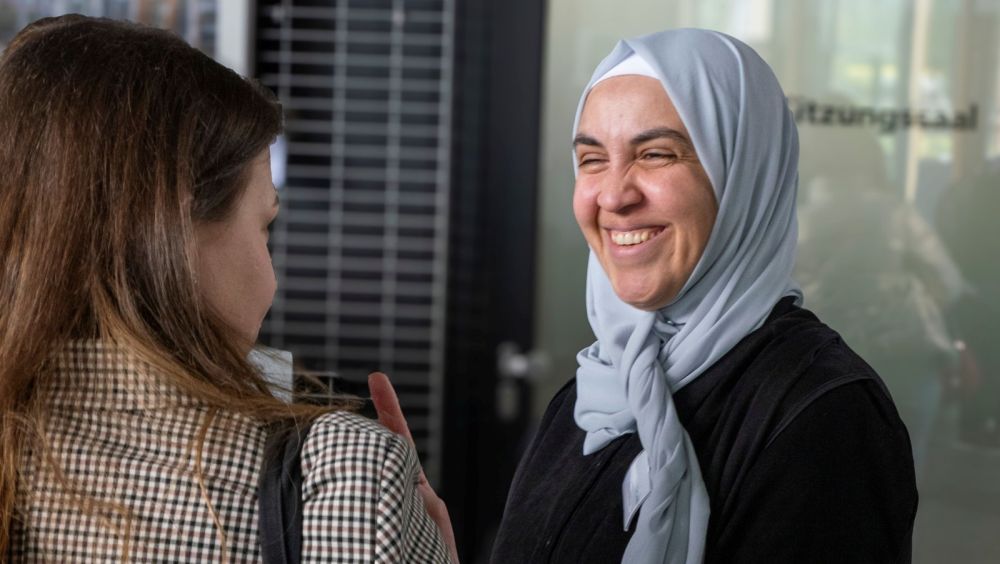
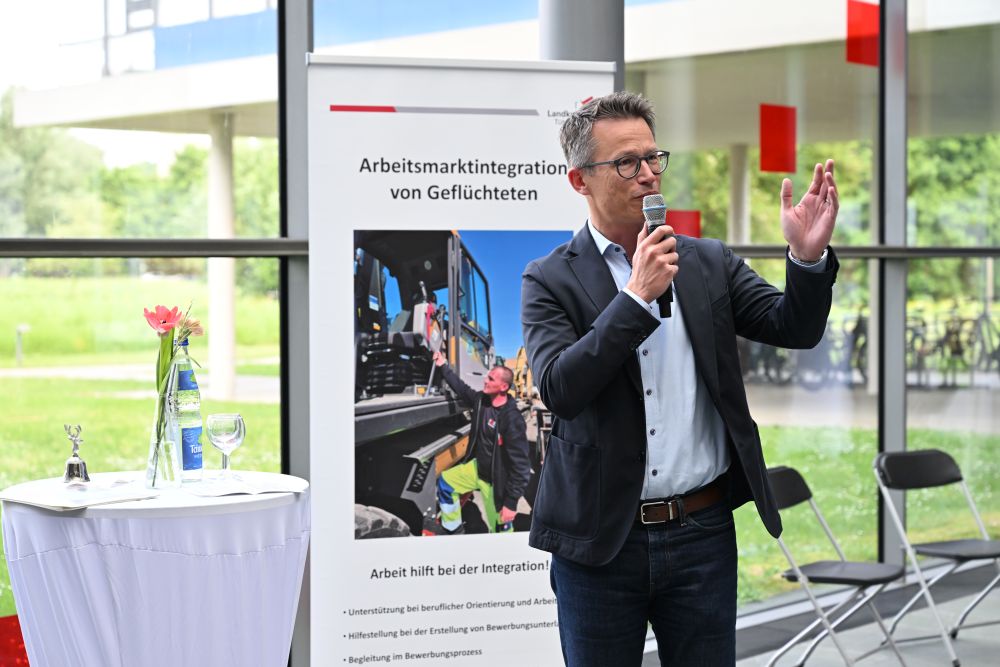
“Integration can only succeed if both sides play their part”: this was the message from Tübingen District Administrator Hendrik Bednarz at the opening of the third Job and Training Fair on 12 May at the District Office. One side consisted of several hundred refugees looking for work. The other comprised over 40 institutions and companies from various sectors offering jobs or training places. During conversations at the stands, it became clear time and again just how important good language skills are.
Raphael Eduah is training at Stadtwerke Tübingen – in the second of a 3.5-year apprenticeship as an electrician for energy and building services. Although he already speaks German well, he continues to work on his language skills after finishing work and vocational school. Technical terms were a major challenge at the start. His colleagues have supported him in this. Eduah found the apprenticeship on his own initiative: he spotted an advert online. His application was successful.

The bricklaying apprenticeship lasts three years
For three hours at the district office, the process was more direct than an online search. Elke Fahrner from the Jobcentre in Tübingen advised visitors to introduce themselves to their preferred company and submit a cover letter. Thomas Knupfer, a state-certified foreman and managing director of K+L-Bau in Dußlingen, which employs 30 people, had already received CVs from two candidates interested in the three-year apprenticeship before the fair had even ended. As a training supervisor, it is important to him that apprentices have a B2 level of German so that they do not struggle too much, particularly at vocational school. Frank Hoffmann, a qualified bricklayer foreman and trainer at the construction firm Jentz in Reutlingen, which employs 75 people from many different countries, also held discussions with several prospective candidates. Anyone wishing to become a bricklayer can apply even with a B1 level. “The technical terms will come gradually,” said Hoffmann in the draughty area outside the district office.
Inside the building, a wide variety of companies were showcasing their services: from the catering industry to Deutsche Bahn, from landscaping to UDO GmbH. With around 800 employees, UDO GmbH acts as a service provider for Tübingen University Hospital, handling catering, building cleaning and logistics. Vanessa Appeltauer from the Balingen-Reutlingen branch of the Federal Employment Agency hoped the world of work would be just as diverse as the range of providers. “People bring a wealth of experience with them,” said the Chief Operating Officer, “which also makes the world a more colourful place within the company.”
Rush for job application photos and care providers
The free job application photos were once again in high demand. Long queues formed outside the room next to the canteen where photographer Frank Pieth was sitting. There was great interest in both McDonald’s and the stands of care providers. Nataliia, from Ukraine, would like to do an apprenticeship. But her B1 qualification isn’t enough. Both the University Hospital and the BG Accident Clinic require a B2 level. Youssef Ouhassane from Morocco, on the other hand, has made it. He found his apprenticeship with the Johanniter after a six-month training course in Morocco via an advert with the Johanniter. He began his three-year apprenticeship there in 2025.
One alternative is offered, for example, by the Kolping Vocational School for Nursing and Care of the Elderly in Rottenburg. The two-year training programme for care of the elderly requires at least an A2 level. Intensive German language support is part of the curriculum. Upon successful completion, those interested can go on to further qualifications, including university studies. The InFö association in Tübingen also offers the ‘Fit for Care Professions’ project specifically for migrants. They receive ongoing support throughout their training and in their job search. In one-to-one meetings, InFö staff also provide advice on applications and CVs.
Four out of six trainees are refugees
The Tübingen-based company Rökona already has experience in integrating refugees. The company produces textiles ranging from T-shirts for the Post Office to car seat covers, treats fabrics such as imitation leather to prevent them from yellowing, and manufactures medical accessories. Gianni LaForza heads the technical training programme. Of the six apprentices in his department, four are refugees, such as Mansour from Afghanistan. The trainer and the apprentice were in high demand as discussion partners.
The numerous visitors to the fair contradicted the image often portrayed of them: “They want to work and settle into society.” This was stated by Sven Jäger, head of the Refugee and Migration Department at the Tübingen District Office. At the start of the event, he expressed the hope that the fair would become “a win-win situation” for both training companies and job seekers. Shortly before the end of the event, he expressed his delight at the “fantastic turnout” of several hundred visitors and the offers – despite the strained economic situation – from more than 40 companies and institutions from Tübingen and the surrounding area.
District Administrator criticises cuts to integration courses
However, there are also downsides, which Tübingen’s District Administrator spoke about. For example, the cut funding for voluntary integration courses. Hendrik Bednarz had also called in a letter to Federal Interior Minister Alexander Dobrindt (CSU) for this decision to be reversed (see report tun26022407). “We need these courses,” said the District Administrator in his opening address. So far, however, the letter-writers have received no reply from Berlin.
Further information:
The event was hosted and organised by Tinatin Khidesheli and the team from the Labour Market Integration Unit at Tübingen District Office.
The District Office’s cooperation partners were the Federal Employment Agency, the Job Centre and the City of Tübingen.
Interpreters provided support in various languages for those who do not yet speak German very well.
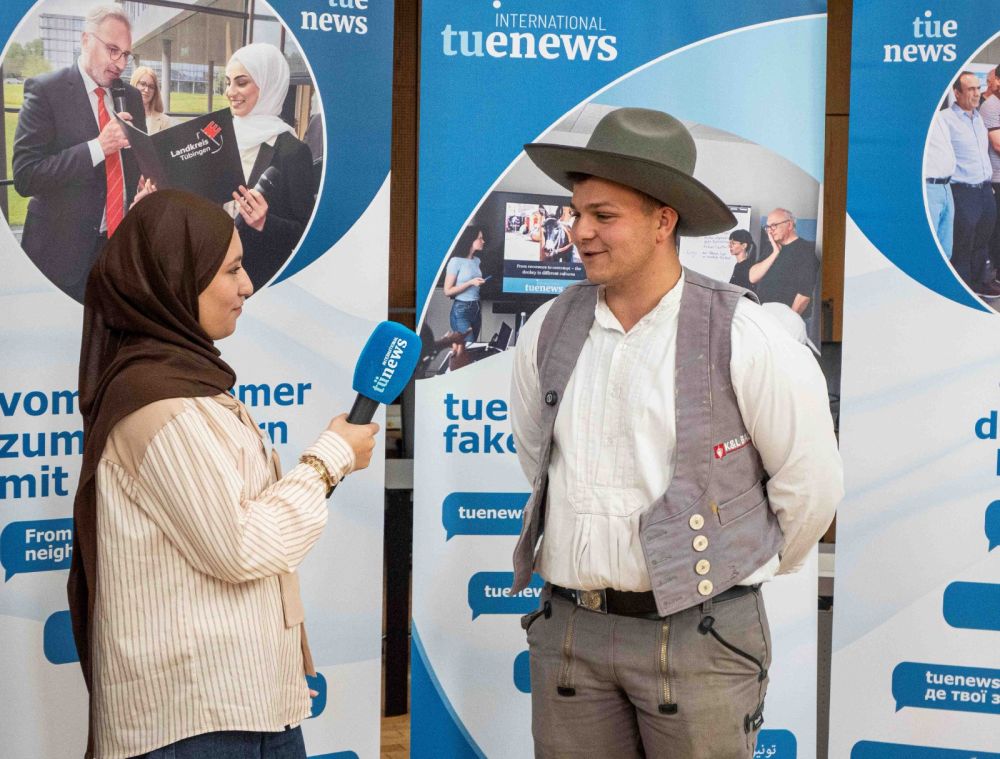
tuenews INTERNATIONAL offered a special service for businesses: they were able to introduce themselves in a video interview.
The posts can be found at: https://www.instagram.com/tuenews.deutsch/
tun26051106