

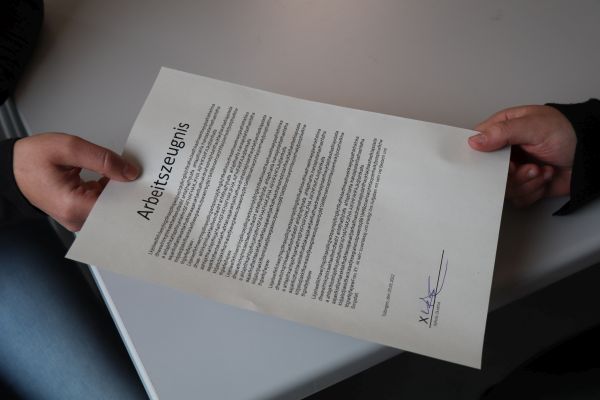
An employment reference can be important when applying for a new job. It shows what duties a person performed at a company, how long they worked there and – depending on the type of reference – how their performance and conduct were assessed. For employers, the reference can therefore be an important factor in their decision-making.
Who is entitled to a reference
A reference is usually issued by the employer at the end of an employment relationship. Employees and trainees have a legal right to one. This is laid down in the Trade Regulation Act, and for trainees in the Vocational Training Act. This applies in principle regardless of nationality or residence status – meaning it also applies to refugees and asylum seekers if they are in employment. Temporary agency workers are also entitled to one.
Types of employment references
There are various types of employment references. A basic employment reference contains details of the individual, the nature of the work and the length of service. It therefore primarily describes what the person did and how long they were employed. It does not include an assessment of performance or conduct.
A detailed employment reference is more comprehensive. It also includes an assessment of work performance, qualifications and conduct during the employment relationship. A qualified reference is therefore usually more useful for future job applications. Employees can insist on receiving a qualified reference. In certain cases, employees may also receive an interim reference: this is the case, for example, when there is a change of manager or someone takes extended parental leave.
How a reference must be worded
A reference must be worded clearly and comprehensibly. It must be truthful, but must not unjustifiably hinder the employee’s future career prospects. Since 2025, references may be issued digitally if the employee consents.
When to request a reference
Anyone leaving a job should ask their employer for a reference as early as possible. It is particularly important for job applications, as proof of professional experience, and for one’s future career.
The pitfalls of reference language
As employers are not allowed to harm employees with a reference, a specific language of references has developed, allowing employers to disguise poor assessments. Some of these phrases are difficult to understand. The statement „zu unserer Zufriedenheit“[tI1] , for example, corresponds only to a school mark of four. For a mark of one, it must say „stets zu unserer vollsten Zufriedenheit“[tI2] This can be found, for example, in an overview by the Verdi trade union. The phrase „arbeitete immer schnell und zügig“[tI3] corresponds to a solid ‘2’. If, on the other hand, it says „arbeitete beständig“ [tI4] this corresponds to a school mark of ‘4’. Anyone who wants to be sure that their reference does not contain any hidden negative messages can seek advice from their relevant trade union or works council. Further information can be found in article tun22033002.
Further information:
https://www.gesetze-im-internet.de/gewo/__109.html
https://www.gesetze-im-internet.de/bbig_2005/__16.html
https://www.gesetze-im-internet.de/bgb/__630.html
https://www.verdi.de/arbeit-recht/arbeitszeugnis-abc-zeugnissprache
tun26042103