

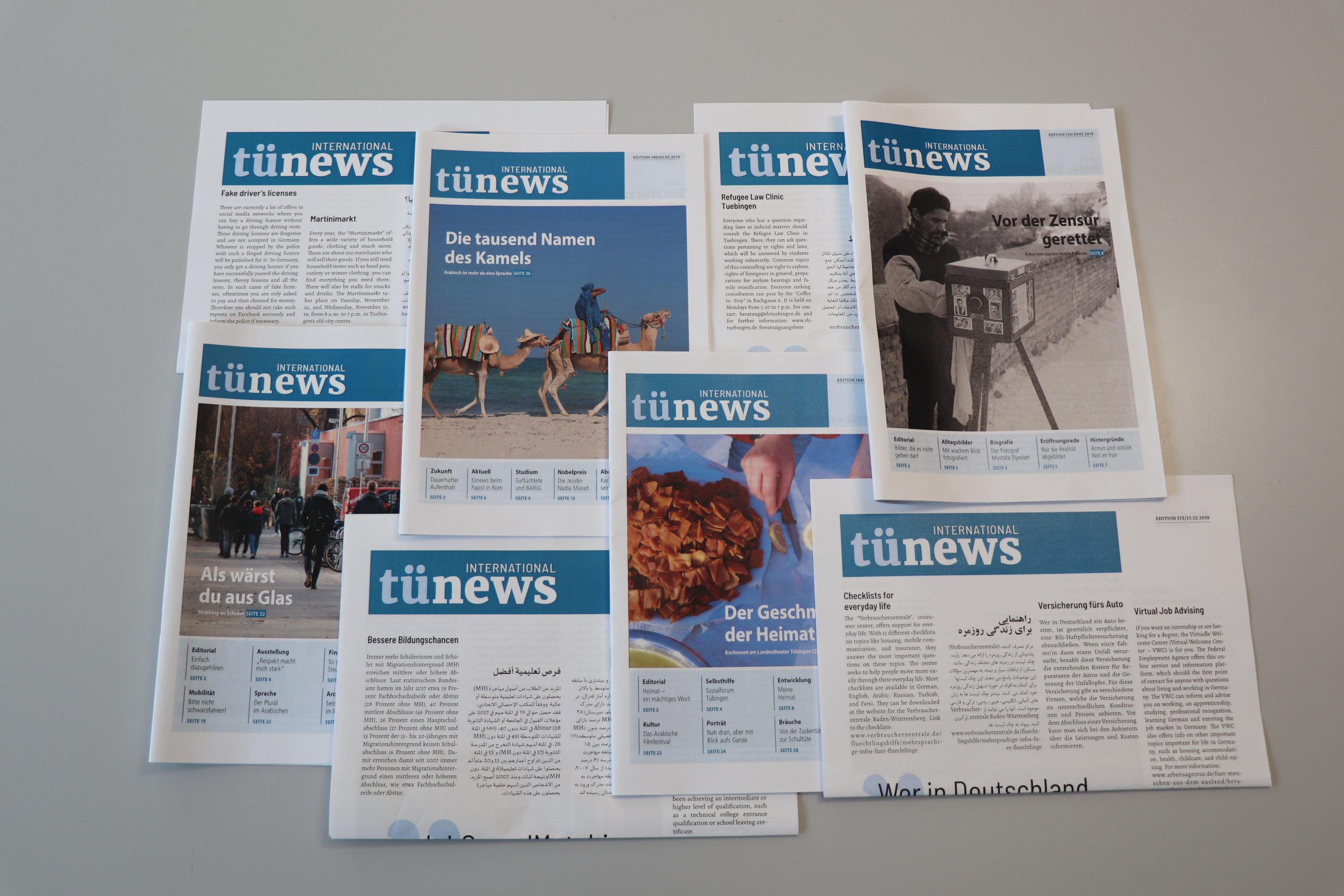
Everything got underway with the arrival of many refugees in the district of Tübingen in mid-September 2015. The first issue of Tünews international—as it was spelled at the time—appeared on 1 December. In his welcoming address, District Administrator Joachim Walter used one word: relevant. What information is important for refugees? This question determined the content of all 240 wall newspapers, magazines and even the special editions on the coronavirus. With the pandemic in spring 2020, the editorial team’s working methods and the distribution of its products changed—see “Corona brings the “digital turn”” (tun25121702).
Back to the beginning with a few highlights: in late autumn 2015, the intercultural team could not have imagined what would become of the media project. It was initiated by Wolfgang Sannwald, whose main job is district archivist and head of public relations at the District Office (LRA), supported by LRA press spokeswoman Martina Guizetti. Together with them, eight women and men set to work with great enthusiasm. Their texts were initially published in English, Arabic, a short German version and soon also in Dari/Farsi for those active in the volunteer circles. The district’s moral and financial support made this possible. The editorial team was also able to count on the adult education centre as a cooperation partner.
Caretakers helped with all problems
An employee from Nigeria gave a clear answer to the question of what is important. In a lengthy article in the zero issue of December 2015, he explained the role that caretakers play in the accommodation facilities in addition to their actual job. These men and women, many of whom have a migrant background themselves, are often the first people refugees encounter. These “caretakers” also helped with everyday life and all kinds of problems—not only in Tübingen, where around 600 refugees found shelter at the end of 2015, but also in Rottenburg (380), Mössingen (200), Kusterdingen (106), as well as Ammerbuch, Bodelshausen and Starzach, each with 50 refugees. Andrea Schmitt was the district administration’s “caretaker” for the media project for a long time. She managed the editorial team on her own at first, then together with Martin Klaus for a while. He joined the team in March 2018 as coordinator and organiser.
A small fee for their work
tuenews INTERNATIONAL, as it is currently spelled, distributed the news in irregularly published print works. A tuenews employee reliably delivered the print products to refugee shelters throughout the district. But just one week after the launch, they also appeared online on the homepage, which was redesigned in May 2019, and on social media. Most of those seeking protection had already used their mobile phones as a source of information while fleeing. Another means of dissemination was radio broadcasts on “Wüsten Welle”. Service announcements and tips played a major role—for example, about places with free internet access. tuenews did not have a large budget. But refugees could earn 1.05 euro for up to 20 hours per month for their voluntary work.
On-site meetings as a source of topics
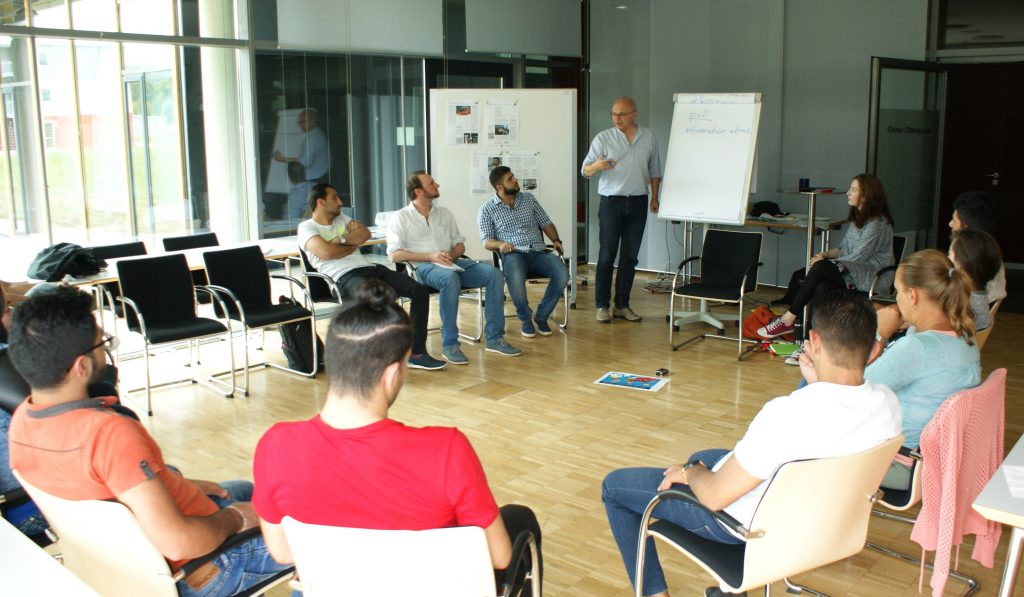
The tuenews editorial team wanted to involve refugees immediately. That’s why, in the sixth issue, the editor offered visits by the team to the accommodation facilities. From 2017, this format was to develop into the “tuenews vor Ort” (tuenews on site) series—a forum for a wide range of topics and suggestions from refugees and volunteers in the Tübingen district. This offer came to an end with the outbreak of Corona.
Language as the key
Editorial staff members themselves brought up one topic at one of the weekly conferences: how important it is to learn the German language. Initially from a service perspective, where language courses are available. In later issues, from a very personal perspective. Their message: language is the key to integration. The topics of arrival, housing and work, including the recognition of professional qualifications, also generated many contributions. From 2020 onwards, there were also more and more informative articles about disinformation on the internet.
Getting to know culture and thinking
It took less than a year after the launch for major topics to appear in a magazine: Heimat, a word for which there is no equivalent in many languages, homesickness and integration. At that time, no one knew how emotionally charged the topic of Heimat would still be in 2025. Current tuenews employees and experienced journalist coaches wrote articles for the autumn issue of the magazine “Schwäbische Heimat” (Swabian Homeland). In an interview in 2016, Wesam said that Syria would always remain his homeland, but that he felt Germany could become his second home. Wesam understood integration to mean getting to know the culture and traditions of Germany, as well as the way people think and live their everyday lives. The refugees from Syria, Iran, Iraq and Afghanistan in the current team have known this for a long time. Many of them are now German. Today, they have two homelands. For them, this also includes tuenews.
The taste of home
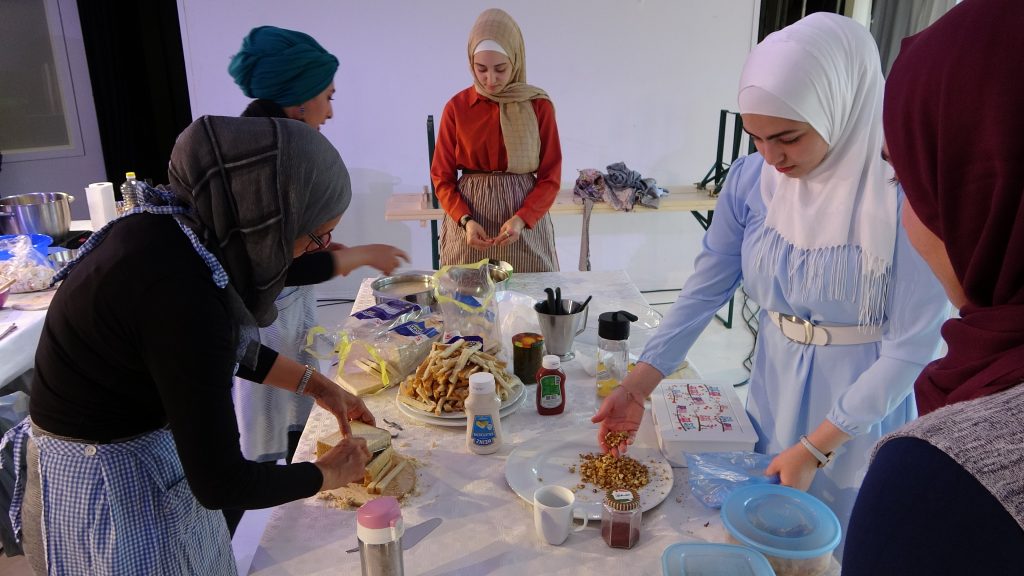
For the editorial team, home also means sharing a sense of community with others. This was particularly evident in September 2019 at a cooking event at the Landestheater Tübingen. The aroma of oriental food attracted 50 guests. Fatima Salehi, Oula Mahfouz and Feras Trayfi prepared local dishes from fish, chicken, lentils, bulgur, rice, aubergines, salad, flatbread and lots of spices—made “just a little bit spicy”, according to Fatima, to suit local palates. After the meal, of which not even a grain of rice was left, refugees and guests struck up conversations with each other. Having fun together is just as important to the editorial team as concentrated work. The internal falafel competition in 2018 is legendary. Whether from Syria or Afghanistan, all the little rolled balls were so delicious that the team decided not to judge them.
“A real treasure”
Leafing through old issues, new faces in the team keep popping up in photos. Not only the refugees who completed their federal voluntary service at tuenews or mini-jobbers went their separate ways, began vocational training or studies. Those who dared to participate in a newspaper project already knew the value of education in their home countries. Several Syrian women worked as teachers. The team included and continues to include a wide range of professional fields: archaeology, aerospace engineering, dental technology and dentistry. One employee is a trained goldsmith, photographer and mountain rescuer. Others are now studying social sciences or medicine. By the 150th edition in August 2019, the editorial team had produced almost 2,000 reports and articles. “This is a real treasure,” summarised editor Sannwald—and promised that it would be continuously expanded and distributed online through various channels.
Social media in Palmyra 2000 years ago
Readers of the publications and the general public have benefited many times over from the knowledge and qualifications of the staff. Back in 2017, Syrian Abdul Baset Kanawi reported to the district administration office on the ancient city of Palmyra, which was destroyed by Islamic State in 2015. Four years later, this city, or more precisely its busts, were the subject of an article entitled “Social media over 2000 years ago?” by Syrian archaeologist Youssef Kanjou. The former director of the museum in Aleppo is conducting research at the University of Tübingen. He has written and continues to write articles on all kinds of cultural and historical topics.
Photographs and music for everyone
In September 2018, Ahmad Salah presented photos by Firus Abdullah depicting everyday life in the Syrian war. This was followed in March 2019 by the exhibition “Saved from Censorship” with photos of social hardship in Tehran. Photographer Mostafa Elyasin had documented the misery from 2001 to 2006 with his camera. This did not please the Iranian censors. The negatives, hidden from them, found their way to Germany via secret channels. Music from the countries of origin played a role not only in the texts. From 2017 to 2019, the “4all” festivals brought it to life at five events under the motto “tü sounds international” with concerts at the Epplehaus in Tübingen and special magazines. Claron Mazzarello had initiated and organised the series. With the lockdown in March 2020, it too became history.
Special issues honoured special topics
The topic of waste and how to deal with it initially generated numerous reports. What happens to waste after it has been collected? tuenews employees asked themselves this question and conducted research at the Dußlingen waste disposal centre in April 2018. Their findings, richly illustrated, were included in Edition 91. This issue provided new insights even for long-time residents. The tuenews team has a wide range of contacts with refugees, which are essential for their journalistic work. In conversations, editorial staff members heard how much refugees appreciate the Tübingen asylum centre and its work. Reason enough to dedicate a special issue to it in 2018 with Edition 117 under the motto “30 years of taking sides for refugees”. 2019 was an election year: locally and across Europe. Under the motto “Voting is valuable”, the district administration called on people to go to the polls. This was intended to encourage eligible voters to exercise their right. On 25 May, tuenews published a special magazine specifically for its target group. Refugees from Afghanistan, Nigeria, Iraq, Iran, Somalia and Syria reported on elections in their countries of origin, which were often ruled by dictatorships and will continue to be so for the most part in 2025. A special magazine on the topic of naturalisation documented in 2021 how well some asylum seekers had already integrated in Germany.
Corona brought about changes
tuenews has continued to develop over the years—not only visually with a new layout and redesigned websites. Long-standing employees have also become increasingly professional. The usual weekly editorial meetings on site at the district office were stimulating and always generated new topics during brainstorming sessions. Almost everything changed in one fell swoop. Just one day before the first lockdown in the district of Tübingen on 17 March 2020, the first special edition on the coronavirus was published, containing all the rules on contact restrictions.
As up to date as possible
With the pandemic, all previous editorial meetings and the usual spontaneity were a thing of the past. The conferences were initially held in writing via WhatsApp, and later via video meetings. This required a great deal of discipline in communication. Editorial assistant Kerstin Markl and a volunteer journalist developed a sporting ambition to publish the latest regulations even late in the evening. Edition 184 was followed by two special issues on the topic, video contributions and over three dozen special editions on the coronavirus. The tuenews editorial team also had to become increasingly professional in terms of technology. But that’s another story.
By Ute Kaiser
tun25121701