

It is not known exactly when the first signs of violence appeared in human history. Nor can it be scientifically determined with certainty whether violence is an innate human trait or a learned behaviour shaped by environmental conditions and social developments over time.
Human history has gone through various stages of development and cultures: from small family and hunter-gatherer groups that were dependent on constant migration and hunting, to settled village communities with an agricultural way of life, to complex societies with monarchical and imperial systems of rule.
Before writing: archaeological evidence of violence
These changes, together with environmental factors, contributed to changing people’s ideas about the nature of their relationships with others. This led directly or indirectly to the emergence of different forms of violence in early societies, which evolved over time and became increasingly complex.
Against this background, the question arises as to what evidence can be used to conclude that violence existed in ancient societies. From today’s perspective, manifestations of violence can be proven primarily through archaeological finds, in particular through defensive structures such as castles and city walls, the spread of weapons and combat equipment, and through bone fractures, injuries and blunt force trauma that can be identified in skeletal remains found in archaeological contexts.
Early evidence of violence can be interpreted as religious rituals
At first glance, human societies in the Neolithic period appear to have lived together largely peacefully. Acts of violence are rarely mentioned. Certain archaeological findings, such as the existence of towers or the discovery of execution sites, are often interpreted as direct evidence of violence in early societies. However, such phenomena must always be viewed in the religious and cultural context of their time. In many cases, these findings are related to ritual practices and social customs that were widespread during this era.
A clear example of this is Tell al-Qaramel in northern Syria, which dates back to the 10th millennium BC. Archaeological excavations at this site uncovered five stone towers and evidence of decapitations in the form of cut marks on the first cervical vertebra. However, these findings do not necessarily indicate organised violence or armed conflict. Rather, the towers discovered are more likely to have served as centres for religious or social gatherings than for defensive purposes. The decapitations are interpreted as part of ritual acts in which the head of the deceased was severed and preserved for ancestor worship rituals—a practice known from numerous early Neolithic sites in the Middle East.
Physical strain caused by Neolithic agriculture
During the agricultural revolution 10,000 years ago, similar to today’s industrial revolution, new ways of life emerged that were reflected in profound changes in daily activities. These included new forms of food procurement, livestock breeding, the construction of permanent houses, increasing competition for resources, and life in closely knit communities.
These changes had an impact on the human body and left characteristic traces on the skeleton. In addition to an increased frequency of bone fractures, changes in joints and bone structures can also be observed, which can be attributed to new physical stresses.
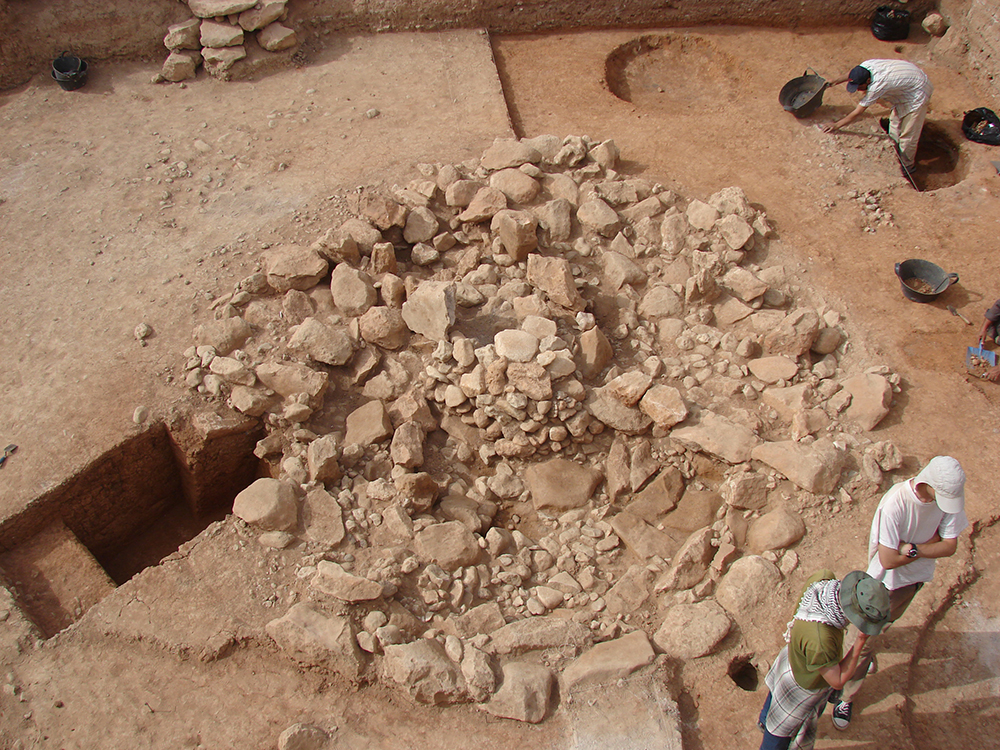
An impressive example of this lifestyle can be found at the Tell Abu Huraira site on the banks of the Euphrates. Early evidence of the domestication of plants and animals and the beginnings of agriculture was discovered there. The human skeletons found at this site show clear evidence of these lifestyle-related changes. However, these findings should not be interpreted as the result of violent conflicts within society, but rather as the result of new working and living conditions, in contrast to later periods in which violence played an increasingly important role.
First battles over water, farmland and trade routes
However, anthropological studies of skeletal remains indicate a significant increase in violence in the middle of the fourth millennium BC. This period preceded the emergence of the first cities and kingdoms and the beginnings of human civilisation. Nevertheless, urbanisation seems to have already begun at this point. Skull injuries and wounds caused by weapons occurred more frequently during this period, which is associated with the introduction of copper fighting tools. These conflicts seem to have arisen primarily from disputes over water resources, fertile farmland and important trade routes.
Early forms of serious internal conflict
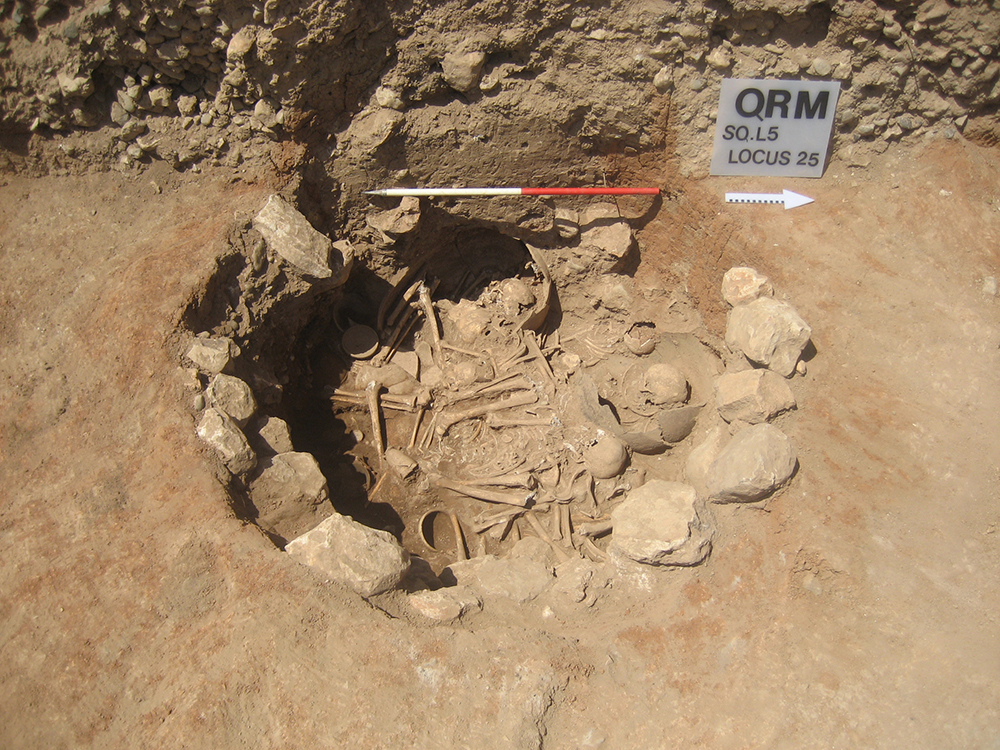
Tell Brak (3800 BC) in north-eastern Syria is one of the clearest examples of this. There, researchers discovered mass graves containing hundreds of skeletons that showed signs of mutilation and evidence of animal predation in the form of bite marks. This suggests that the bodies were initially left unburied and then disposed of in waste pits without any burial rituals. Researchers interpret this phenomenon as an indication of serious internal conflicts within the society of that time, which in their intensity can be compared to today’s concept of a “civil war”. It is also striking that most of the victims were young adults, while skeletons of children and older people are largely absent.
Escalation of violence with sieges
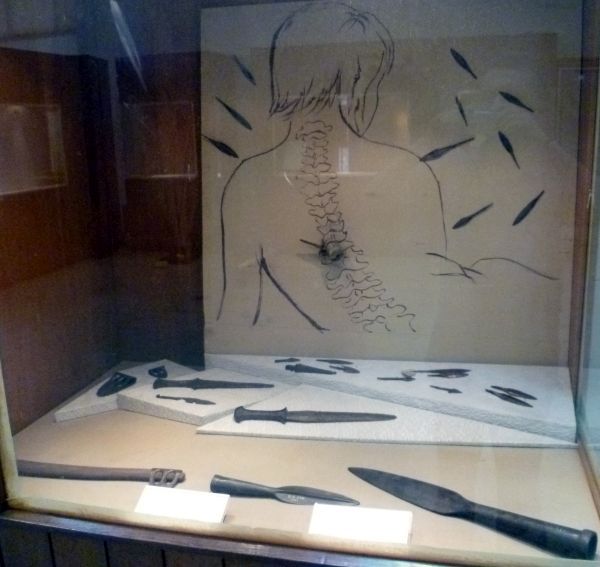
Tell Hamoukar (3500 BC), also in north-eastern Syria, provided the earliest known evidence to date of a large-scale military siege and organised invasion in what is now Syria. Archaeological investigations revealed the remains of a destroyed city wall, thousands of clay projectiles in the form of egg-shaped sling stones scattered across the entire area, and the complete destruction and burning of large buildings. These findings indicate that the city was systematically attacked, looted and finally destroyed.
In the 3rd millennium BC, violence took on a completely new form, particularly with the emergence of the first cities and kingdoms. As a result of increasingly escalating conflicts over property, resources and political power, violence shifted from individual or local disputes to organised conflicts between state-structured communities.
Further information:
https://www.spiegel.de/wissenschaft/mensch/archaeologie-der-erste-krieg-der-menschheit-a-460283.html
https://tuenews.de/vor-6000-jahren-fand-der-erste-krieg-auf-syrischem-boden-statt-2/
By Youssef Kanjou
tun26011306