

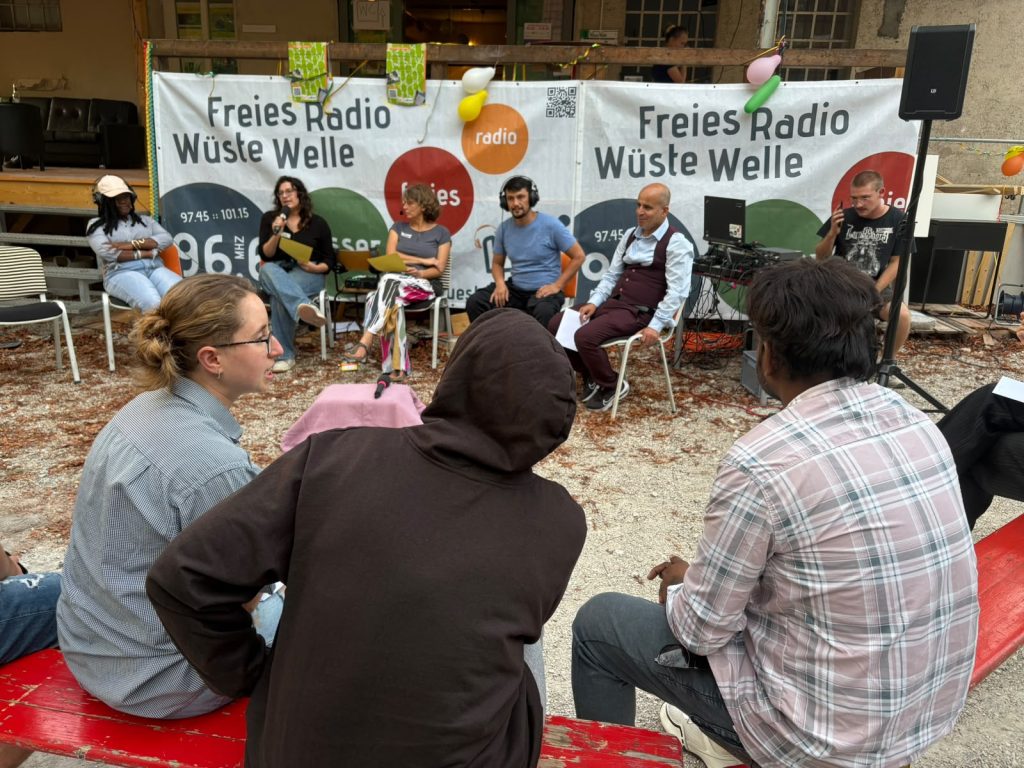
Tübingen is one of the cities in the region that aims to be a “safe haven” for people with refugee backgrounds. What is the reality? And: What is missing for this goal to be achieved? Refugees and supporters shared their answers with Freies Radio Wüste Welle in front of the Sudhaus in Tübingen.
Do refugees really feel welcome in Tübingen? That was Anna Trautwein’s first question. Together with Pauline Menghini, she moderated the event, which was broadcast live on the radio. Over the course of two hours, the discussion focused on both personal experiences and future prospects—a contribution to the “Can the City Speak?” project. The radio team has been working on this project for two years. The city administration was not represented that evening.
Nightmares and No Home or Job
The responses—some of which were translated simultaneously—showed that there is still much work to be done before people with refugee backgrounds can feel like part of the city’s community. Anita from Togo suffers from fear and nightmares because the Federal Office for Migration and Refugees (BAMF) did not believe her reasons for fleeing. The BAMF also rejected Ali’s application. “Why would anyone leave their home country?” asked the man who fled Afghanistan to escape the Taliban. It’s difficult to find an apartment and a job, said Bashir, a father of four. His many job applications have been unsuccessful.
A culture of welcome and good counseling centers
Guests “who support refugees,” as Menghini put it, were also invited to speak into the microphone. Ruben Malina from the Tübingen Asylum Center reported on the complicated housing situation, the uncertain legal status, and the difficulty of obtaining a work permit. He is familiar with this plight from his counseling sessions. Robin coordinates the work of volunteers at the Asylum Center. She sees a dilemma: On the one hand, volunteers support people with refugee backgrounds. On the other hand, professional work might be shifted onto unpaid volunteers. Gitta Rosenkranz, a certified social worker and city council member for The Left in Tübingen, spoke on this topic. Settling in here and having a future “requires a culture of welcome and good counseling centers.” These centers must have “secure funding.”
The current situation? “It’s getting harder and harder for migrants,” said Malina. As an example, he cited the naturalization test, which includes questions such as those about all German chancellors. The man from the asylum center called for “more political pressure” on decision-makers and asylum authorities “so that they make use of their leeway.” Local politician Rosenkranz criticized the fact that no kitchen is planned for the proposed initial reception center for about 750 refugees. She noted that a kitchen is an important place where people can meet and feel at home.
Helping Shape Life in the City
Baraa, Laya, and Julie have found a safe place in Tübingen: the girls’ club. Baraa, who has lived in Tübingen for twelve years, has endured a great deal as a “girl who wears a headscarf”—being verbally abused, shoved, and spat on. The worst part: “Nobody did anything.” It would already help her if she were left alone, “if people can’t accept me.” The three advocate for the interests of young people on the Youth City Council. Laya and Julie see this as an opportunity: to help shape the future. Texts written by the trio on the theme “Writing for the Soul” are currently on display at the Hölderlin Tower.
More Dialogue Against Racism
Everyday racism at school, at work, or in institutions hits hard. Malina hears about this experience time and again—whether from immigrant caregivers or tradespeople who aren’t allowed into people’s homes. “Racism prevents successful integration”: Rosenkranz is convinced of this. What needs to change? “Society must recognize the enrichment that immigration brings,” says Rosenkranz. Other proposed solutions ranged from “more translators”—suggested by French-speaking Anita—to “(non-commercial) places to exchange ideas with others”—suggested by Laya—to “more events like this one”—suggested by Rosenkranz.
It Can Also Turn Out Positively
The guests heard an encouraging story before enjoying the West African meal. Mohamad, who has been in Germany for just under two years, has found a full-time job as a tailor in Pfullingen and has “no problem” with the language at work. To further improve his German skills, he attends an A2 course after work.
tun26093001