

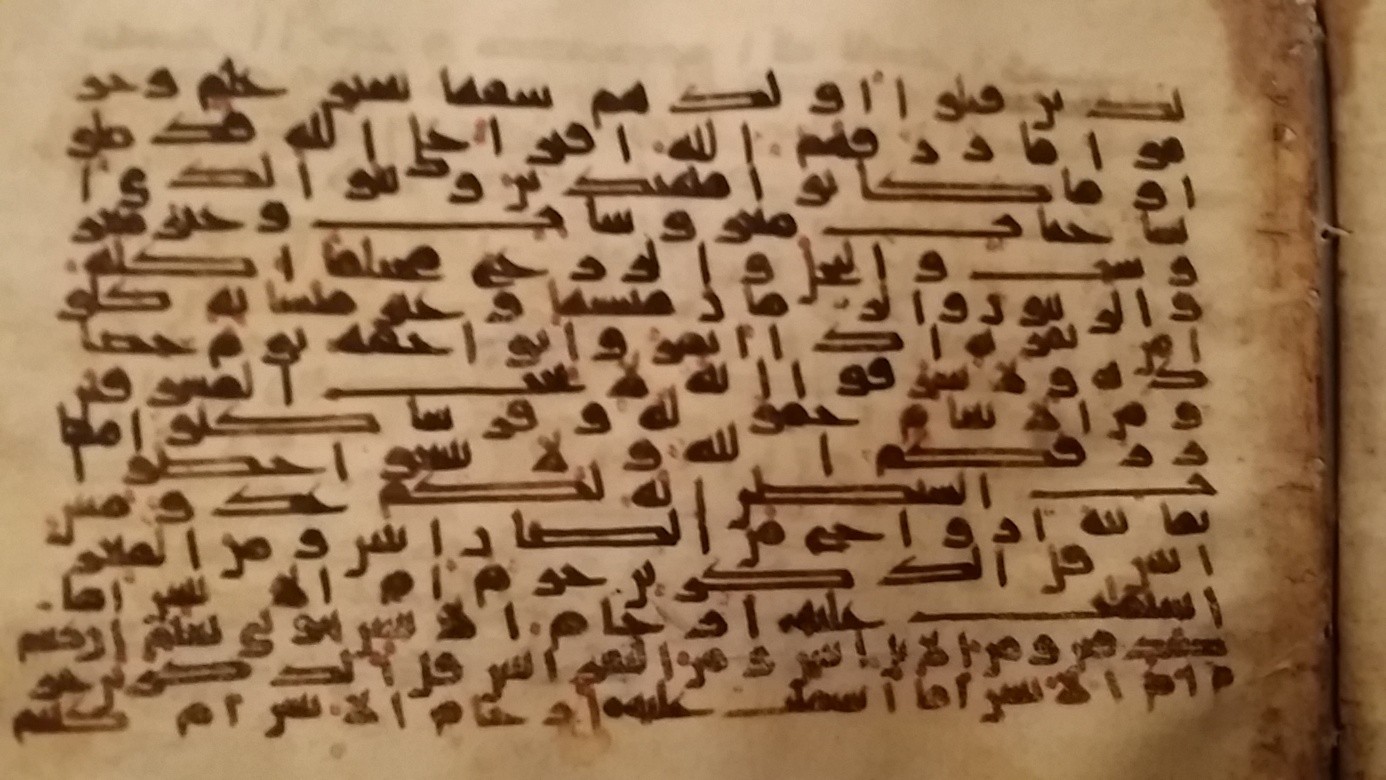
The University Library of Tübingen houses one of the oldest and most important manuscripts of the Qur’an – the holy scripture of Islam, which is understood as God’s revelation to the Prophet Muhammad. This article aims to explain the significance of this manuscript in the tradition and how it came to be in Tübingen of all places. First, however, we shall look at the origins of the Qur’an.
Gradual revelation of the content
The history of the Qur’an begins in the year 610 AD in Mecca. According to tradition, the Prophet Muhammad is said to have regularly withdrawn to the Cave of Hira on Mount Jabal an-Nur for prayer. There, the angel Gabriel is said to have appeared to him and revealed the first verses of the Qur’an. According to tradition, the Qur’an was not revealed all at once, but over a period of approximately 23 years. This period began when the Prophet was around 40 years old and ended with his death at the age of 63. From an Islamic perspective, this gradual revelation served several purposes. These included supporting the Prophet, gradually introducing religious teachings to the faithful, and facilitating the memorisation and practical application of the teachings.

Oral and written transmission
Historians of Islam are in agreement regarding the transmission of the Qur’an in the early days of Islam: according to them, it was transmitted both orally and in writing during the lifetime of the Prophet Muhammad. Many of his companions learnt the revealed verses by heart and passed them on. At the same time, the Prophet is said to have attached great importance to recording the revelations in writing. Exactly when the practice of written transmission began is a matter of debate amongst scholars. As paper as we know it today did not exist at that time, the texts were recorded on various materials, including parchment, animal bones (particularly shoulder blades), wooden tablets and flat stones. This gave rise to a close connection between oral transmission and written documentation.
Standardisation of the Qur’an following the death of Muhammad
Following the death of the Prophet Muhammad, the Battle of Yamama took place, in which many of his companions who knew the Qur’an by heart lost their lives. Fearing the possible loss of parts of the tradition, Umar ibn al-Khattab proposed to the then Caliph Abu Bakr that the Qur’an be compiled into a standardised written collection. Zaid ibn Thabit, a former scribe of the Prophet, was entrusted with this task. He collected and verified all existing Qur’anic texts and compiled them in written form for the first time. Under the third caliph, Uthman ibn Affan (644 to 656 AD), several standardised copies were produced on the basis of this collection and sent to various regions of the Islamic Empire. This was intended to ensure that the Qur’an was read in the same form everywhere.
The three oldest surviving manuscripts
Some very early copies have survived to this day. Among the best known are three that are frequently cited in scholarly circles in chronological order: the oldest is the so-called Birmingham Manuscript, followed by the Tübingen Qur’an manuscript and the Sana’a manuscript. These early manuscripts show a high degree of consistency in the Qur’anic text and are often regarded by scholars as evidence of an early standardisation of the tradition.
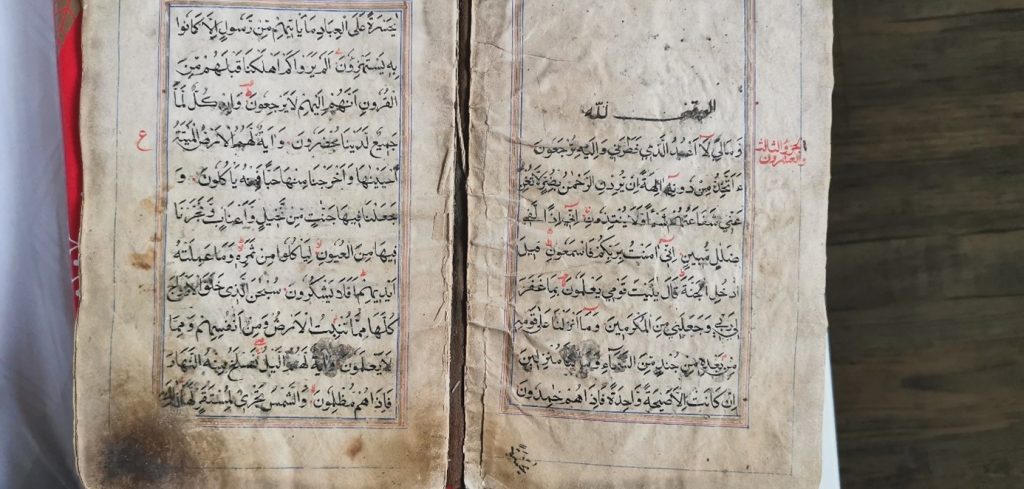
Why Tübingen of all places?
The University Library of Tübingen acquired the manuscript in 1864 as part of the private collection of the Prussian consul in Damascus, Johann Gottfried Wetzstein. This diplomat was also a trained Orientalist and collected Islamic manuscripts. The Qur’an manuscript was kept in the library’s archives for over a century without its actual age being known.
It was examined using the scientific radiocarbon dating method at ETH Zurich as part of a major international project called ‘Coranica’. The aim of the project was to investigate the history of the Qur’anic text on the basis of early manuscripts. The results of the analysis showed that the parchment used for the Tübingen manuscript dates, with a probability of over 95 per cent, from the period between 649 and 675 AD. This means that these pages were produced shortly after the death of the Prophet Muhammad (632 AD), i.e. around 20 to 40 years later.
Ancient script on parchment
The text was written on parchment made from animal skin in a very early Arabic script, which represents a transitional phase to the early Kufic script and is usually classified as belonging to the Hijazi script group. This script is characterised by slanted and elongated letters and contains neither diacritical marks nor vowel signs, such as those used today to distinguish between letters and ensure legibility.
The Birmingham manuscript is considered to be even older than the Tübingen manuscript and is dated to before 645 AD. The Sana’a manuscript, which was discovered in 1972 during the restoration of the Great Mosque in Sana’a, is regarded as one of the most significant Islamic archaeological finds of modern times. Research has shown that the lowest layer of the manuscript dates back to before the year 671 AD. What makes this manuscript unique is that it is a palimpsest: an older text was removed and replaced by another Qur’anic text. This provides important scholarly material for research into the history of Qur’anic script.
The Tübingen manuscript is available online
The Tübingen manuscript (call number Ma VI 165) forms part of a collection of more than 20 Qur’an manuscripts held by the University Library of Tübingen. It contains sections of the Qur’anic surahs from Surah al-Isra’ (17) to Surah Yasin (36). The University Library of Tübingen has fully digitised the manuscript and made it available online in high resolution to researchers and the public.
All pages can be viewed via the library’s official link:
https://opendigi.ub.uni-tuebingen.de/opendigi/MaVI165#p=11
Further information:
https://uni-tuebingen.de/newsfullview-landingpage/article/raritaet-entdeckt-koranhandschrift-stammt-aus-der-fruehzeit-des-islam/
tun26051107