

By Stefan Krmnicek
At the University of Tübingen, 2024 researchers collaborated with blacksmith Alexander Zimmermann from Pliezhausen to act as scientific counterfeiters in order to find out how coins were counterfeited in the ancient Roman Empire. The interdisciplinary project involved the disciplines of numismatics, archaeology and mineralogy.
During the Roman Empire, the state minted denarii—coins made of silver. One denarius was roughly equivalent to a worker’s daily wage. The denarius had a wider reach than today’s euro: the Roman Empire stretched from Britain in the north to Tunisia in the south and from Spain to Syria. In the early 3rd century AD, the silver content of denarii was greatly reduced by the state. This was also noticed by contemporaries in ancient times: presumably in response to this devaluation, counterfeit coins were produced in the Roman Empire, imitating the silver denarii with a copper-tin mixture called an alloy. The Tübingen team succeeded in reconstructing the manufacturing process of these coins for the first time.
Making moulds with real coins
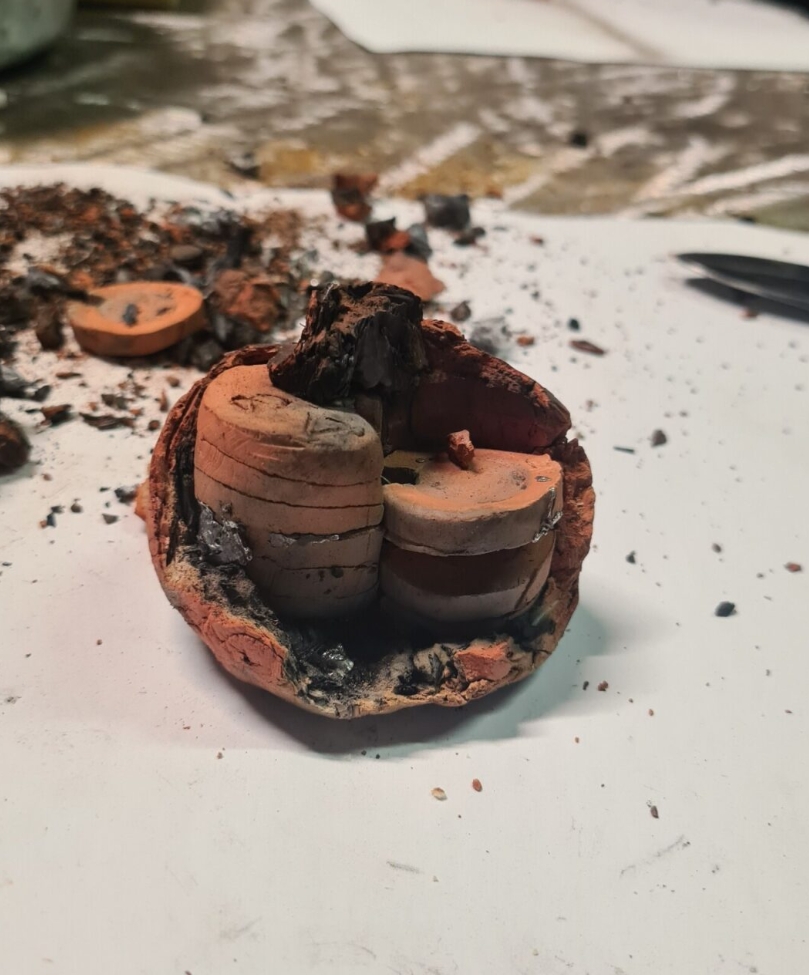
To produce counterfeit denarii, ancient counterfeiters first made small moulds, which are well documented by numerous archaeological finds throughout the Roman Empire. Small clay discs were used as moulds, into which the front and back sides of real coins were pressed while still moist. In serial production, entire stacks of pressed clay discs can be produced. Before the clay dries to a leather-hard consistency, an indentation must be carved across the entire stack, from the pressed coins to the edge of the clay discs. This later serves as a casting channel during casting. Once the moulds have dried, the coins can be carefully removed. This creates the actual casting moulds or casting chambers with the negative impression of the coin, into which the alloy is later poured. The moulds are then fired in a kiln. The reduction of the clay during firing causes the moulds to shrink by almost 10 per cent. This means that the counterfeits produced by the casting process are correspondingly smaller than genuine coins
Before the actual casting can take place, the moulds must be positioned. To do this, as evidenced by ancient finds, three stacks of moulds were assembled with the incision in the middle and coated with coarse clay. This creates a vertical casting channel in the middle of the three moulds. In the experimental setup, thermocouples were also embedded to record the temperature curves.
Copper and tin instead of silver
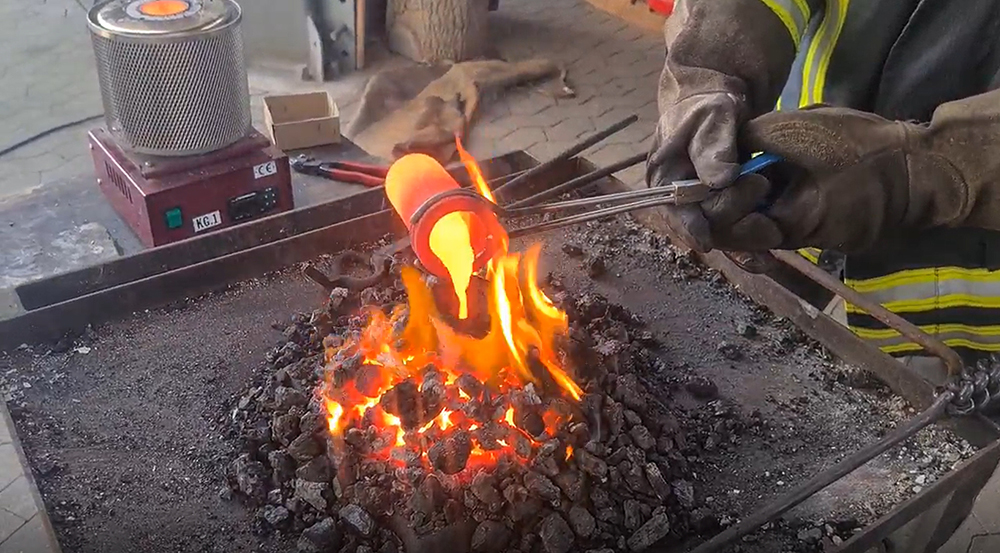
The ancient counterfeiters used an alloy of copper and tin as the metallic material. With a ratio of about 30 percent tin and 70 percent copper, the finished casting appears silvery to steel grey—ideal for imitating a genuine silver coin. For practical reasons, the alloy, which melts at over 1000 °C, was produced in the project using an electric melting furnace. For the Roman counterfeiters, on the other hand, the preparation of the metal in this step must have been a major challenge. Not everyone in ancient times was capable of this; achieving such a high temperature required profound technical knowledge and corresponding experience.
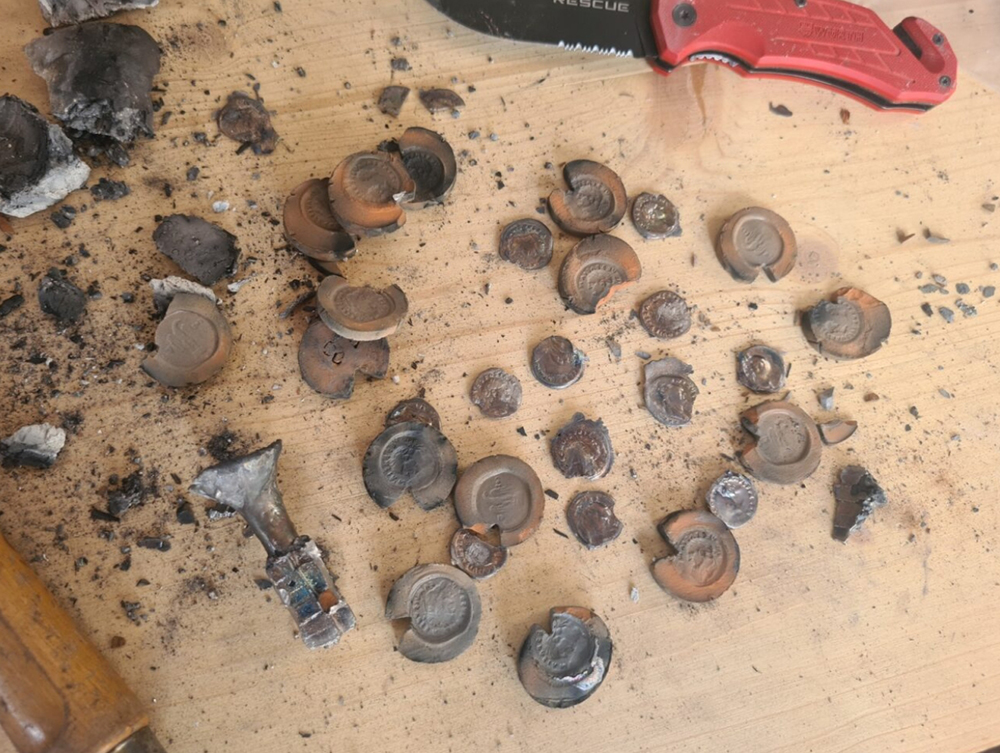
The Tübingen experiment showed that the clay moulds, including their casings, had to be heated to a high temperature before the molten metal, which was almost 1000 °C, was poured in, as this prevented the residual moisture from evaporating during casting and thus resulted in cleaner castings. After the moulds have cooled down, the coating can be broken open and the moulds smashed to access the metal casting tree, from which the coins can now be carefully broken off.
Failed counterfeits are recycled
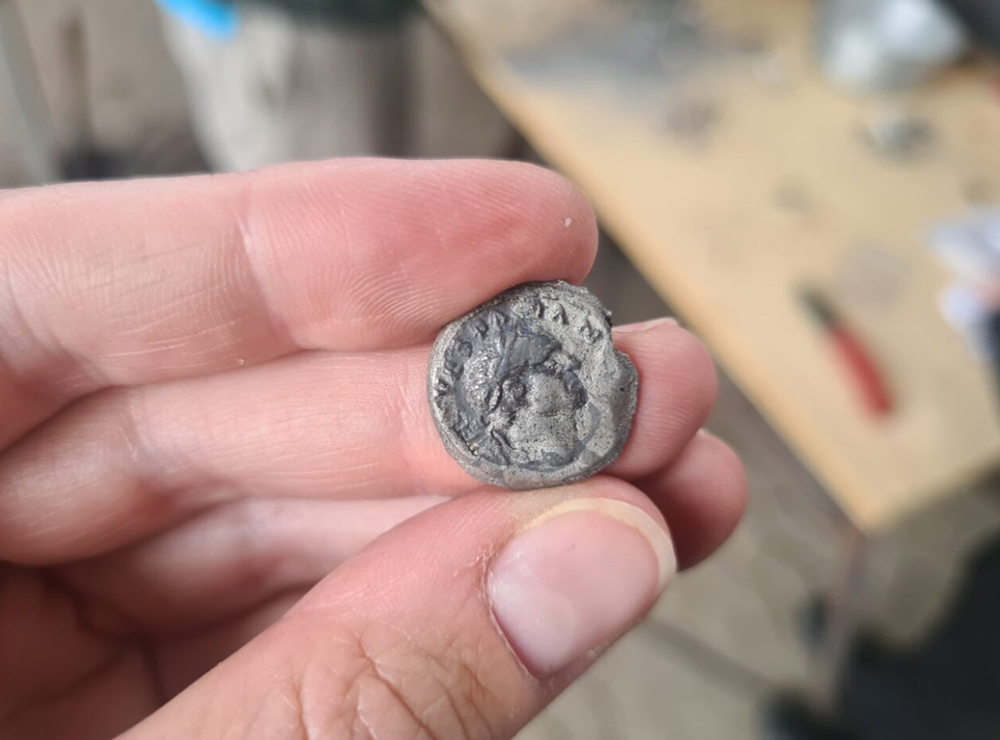
Some of the successfully cast coins showed coloured oxide layers in purple, gold and blue, which were caused by rapid cooling. Such effects are also likely to have occurred in ancient coins. Despite post-processing, more than 50 per cent of the casts in the experiments were defective and would not have been accepted as deceptively genuine counterfeits in everyday life. This would have been no different in ancient times. Failed casts were recycled and are therefore also missing from archaeological excavations.
The practical reconstruction in the Tübingen experiment illustrates that Roman coin casting was a demanding technical process that required both metallurgical and ceramic expertise. This suggests the existence of specialised workshops and experienced craftsmen. Our experiment shows that a large number of coins could be produced within a day and that counterfeiting must have been a lucrative business.
A vivid video of the experiment can be found on YouTube at:
YouTube—How the Romans counterfeited coins
tun25112403