

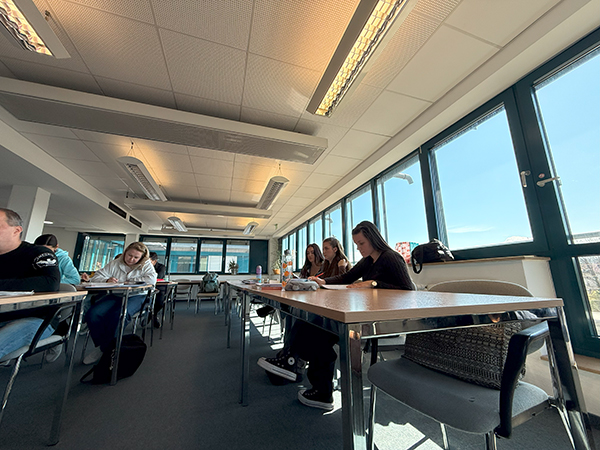
The vast majority of refugees who arrived in Germany in 2015 and 2016 had no knowledge of German. A survey conducted in 2023 revealed that language acquisition among this cohort was very successful. According to the survey, more than 90% had at least an intermediate level of German, with the majority even having good or very good German skills. These data are based on the self-assessment of over 6,300 respondents in interviews. After 7 to 8 years in Germany, only a minority of less than 9% stated that they had poor or no German skills. These figures were published by the Federal Office for Migration and Refugees (BAMF) in a press release.
The author of the study, Dr Jan Eckhard, explains the results: “From October 2015, integration courses were also opened up to refugees with good prospects of remaining in the country whose asylum procedures had not yet been completed. This enabled many refugees to access integration courses more quickly.” For subsequent cohorts—especially refugees who arrived between 2019 and 2021—the pandemic-related restrictions of 2020 and 2021 had a negative impact on their language acquisition. In addition to the more difficult conditions for socialising, the opportunities for refugees who came to Germany during or shortly before the pandemic to participate in language courses were particularly limited, according to the researcher.
The evaluation is based on a study involving annual surveys conducted by the Research Centre of the Federal Office for Migration and Refugees in cooperation with the Institute for Employment Research and the Socio-Economic Panel at the German Institute for Economic Research in Berlin (DIW).
Press release and brief analysis of the evaluation:
BAMF – Federal Office for Migration and Refugees – Infothek – Language acquisition among refugees in 2015 and 2016 was particularly successful
tun26011304