


Most archaeologists who study the prehistoric periods of human history in Europe now assume that there was no inter-group violence or warfare during the early incursions of modern humans (Homo sapiens) into Europe during the Palaeolithic era, which began 45,000 years ago. At least, there is as yet no archaeological evidence to suggest otherwise. During and between the ice ages, people lived as hunter-gatherers in small groups across vast uninhabited landscapes with an extremely low population density. Their weapons were used for hunting; whilst they could also be used to kill people, there is no evidence of technological developments designed for use as weapons in group combat. This overturns older theories which assume that violence and war have accompanied human evolution and prehistory from the very beginning.
In his research for tünews INTERNATIONAL, Youssef Kanjou has established that, in the Middle East, a clear increase in violence can be observed over the past 7,500 years based on bone finds (see tun26011306). “These conflicts appear to have arisen primarily from disputes over water resources, fertile farmland and important trade routes,” writes Kanjou, who sees this shift in the context of the establishment of agriculture, the adoption of a sedentary lifestyle in permanent settlements, and the first signs of urbanisation.
After the peaceful Ice Age: Agriculture and violence from the East
Around 7,500 years ago, a massive wave of migration also began, with farmers spreading rapidly from what is now Anatolia along the Balkan route towards Europe―a movement that could be characterised by the motto “Go West”, much like in 19th-century North America. If a territory no longer yielded a harvest, or if the population density became too high to feed everyone, people moved on. The German archaeologist Harald Meller notes that the peaceful times came to an end due to rising population numbers and a climate change characterised by severe drought and consequent crop failures. “The invention of private property seems to have been the catalyst for the birth of war,” sums up the German archaeologist Harald Meller, thereby explaining the development of violent conflicts following the emergence of agriculture and settled life.
These recent archaeological findings are also corroborated by the results of ethnographic research. These show that nomadic hunters and gatherers reject the concept of property. Instead, the sharing of hunting spoils and food is the norm. Property is viewed as an affront to human solidarity.
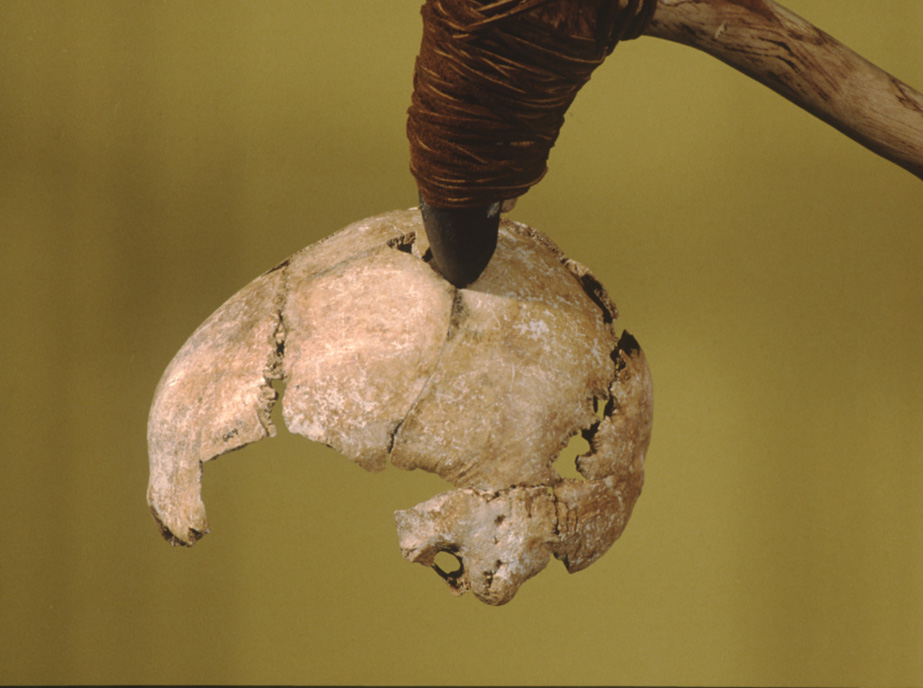
First massacres in the Linear Pottery culture
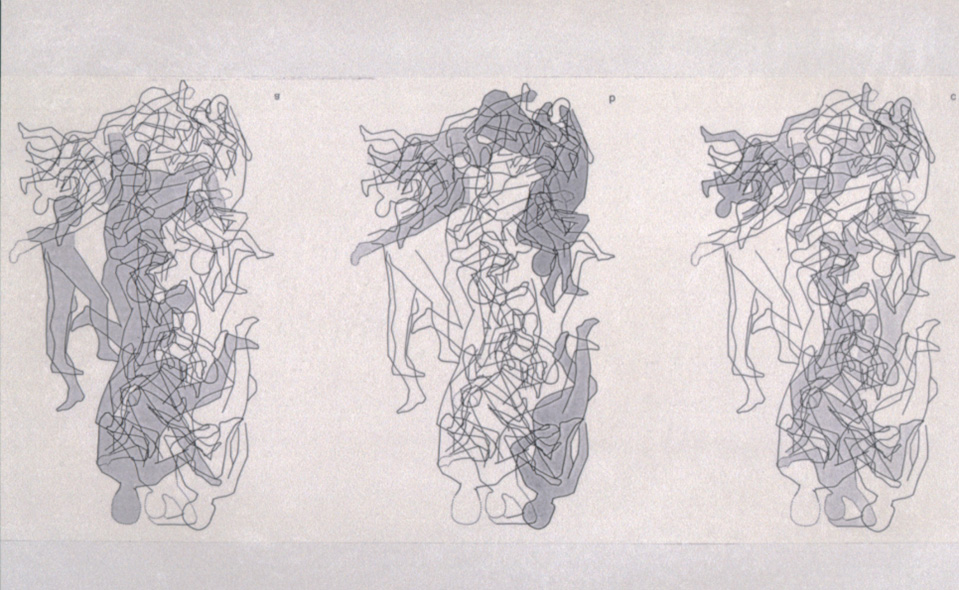
Archaeological finds provide evidence of outright massacres, which can be traced to four sites in what is now German-speaking territory, as well as in Western and Southern Europe. In Talheim, near Heilbronn, a mass grave containing 34 individuals was excavated; they had been killed with stone hoes and thrown haphazardly into a pit: men, women, children and adolescents, who can be genetically traced to four families. The finds, which date back some 7,000 years, reveal excessive violence against people fleeing, inflicted through repeated blows from behind. In Asparn-Schletz in Lower Austria, around 200 people were found who had been killed in close combat with stone and wooden weapons. Among the dead, who were left lying where they fell and show signs of animal bites, there are no young women. Finally, two further mass graves were discovered in Hesse and Saxony-Anhalt, which also contain no female victims.
These four cases all belong to the Linear Pottery culture, dating from when it reached its peak population density. It is the oldest farming culture in Central Europe, named after its characteristic ceramic vessels, which feature a band pattern of wavy lines. The massacres are interpreted as violent clashes between tribal confederations or village communities; the finds from Talheim are seen as a possible raid or an act of revenge. In the three remaining cases, the women of marriageable age apparently survived and may have been abducted.
Male dominance and the abduction of women
Archaeologists further conclude from the finds that a clear male dominance emerged in the Neolithic agricultural communities, with property being inherited through the male line. The women often came from other communities, as genetic evidence obtained from bones shows. An aggressive pioneer mentality developed as farmers expanded into Europe. Neighbours and cooperative partners could easily become enemies through the accumulation of property. Violence became the norm; violence was met with counter-violence: blood feuds became the social norm.
A frequent shortage of women was caused by polygamy among men of higher status, by higher rates of fatal pregnancies compared to earlier nomads, by a heavier workload in agriculture, and by epidemics resulting from close cohabitation with animals. Military campaigns to capture women from other village communities presented themselves as a solution. Harald Meller sums it up: “Men are killed, women and children are abducted; this becomes the horrific basic pattern of the wars.” There are battles between settlements and between tribes; there is as yet no higher authority to curb the violence. The danger of being raided also forces people to carry out pre-emptive raids.
Fortifications for defence
The first defensive ramparts appeared 7,000 years ago, so-called earthworks, some of which were fitted with palisades. Complex fortifications with double palisades and multiple defensive rings emerged 6,000 years ago. Settlements were often built on high ground, whose steep slopes offered protection on several sides, so that fortifications did not need to be built all around. The fact that armed conflicts took place in and around such sites is often evidenced by several hundred arrowheads found there.
In the sixth millennium BC, evidence can finally be found of full-scale conquest campaigns that led to the downfall of entire cultures. For instance, the so-called “Funnel Beaker People”, former hunter-gatherers who had retreated northwards and become farmers there, conquered the territory of the agricultural “Linear Pottery Culture”, whose culture then disappeared entirely. Both cultures represent genetically distinct groups.
The Heroisation of Warriors
According to modern archaeological findings, the transition from the Neolithic to the Bronze Age saw the emergence of a wholly new dimension of warfare: the invasion of the so-called “Corded Ware people”, steppe horsemen from Central Asia into Europe, led to the professionalisation and “heroisation of violence”. Their weapons demonstrate technological superiority; battle axes, daggers and perfected bows are developed, allowing for greater arrow velocity. Their culture features heroes’ graves for professional warriors, lavishly furnished with weapons. More monumental structures are erected than before, serving not only as deterrents and defences but also representing social hierarchies. This development continues towards urbanisation and the formation of larger confederations into kingdoms, leading to state-organised wars.
This article draws heavily on the current standard work: Harald Meller et al.: “The Evolution of Violence. Why We Want Peace but Wage War. A History of Humanity.” Munich 2024, in particular pages 133 to 236.
Further information:
Europe’s Neolithic Age: Hundreds were bludgeoned to death, dismembered and stripped of their flesh―WELT
Crime Scene: Stone Age Warning: this Terra X film contains re-enacted scenes of violence that may be disturbing.
Related articles on tuenews INTERNATIONAL:
Violence in human history: findings and developments
Where agriculture was invented and how it came to Europe – tuenews
Migration brought fair skin to Europe – tuenews
By Michael Seifert
tun26040801