

By Youssef Kanjou and Michael Seifert
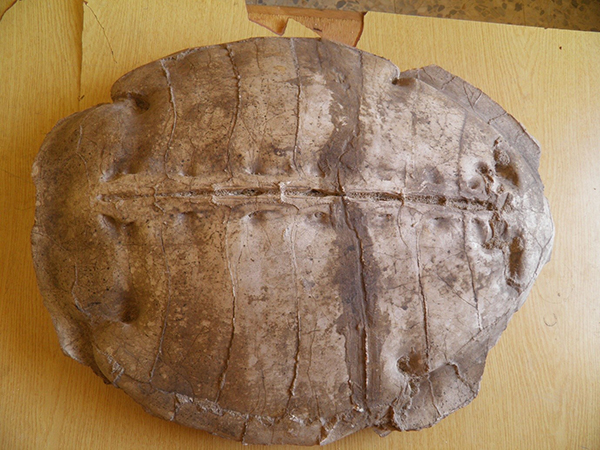
An international team of palaeontologists from Syria, Brazil and the University of Tübingen has discovered a previously unknown extinct species of sea turtle in northern Syria—a discovery that is unique in this country to date. The study, published in 2025 in the journal Papers in Palaeontology, contains a detailed scientific description of the animal, which has been named Syriemys lelunensis (Syrian turtle from Leloun) after the site where it was found on Mount Leloun near the town of Afrin in rural Aleppo, Syria.
What is known about the Syrian turtle of Leloun
The fossil was found in 2010 in a limestone quarry and underwent extensive examination using computer tomography (CT) and microscopic analysis techniques in the following years. The results showed that the sea turtle dates back to the early Eocene epoch (about 56 million years ago), making it the oldest confirmed find of the marine family Stereogenyini (a special group of pig-nosed turtles) and extending the history of this group by more than ten million years compared to previous knowledge.
The new sea turtle species has unique anatomical features in its bony shell, pelvic bones and limbs, confirming that it is a previously unknown species. Researchers believe that the ancestors of these sea turtles spread across the Mediterranean to the oceans of the Old World during periods of high sea level in the Eocene. Present-day Syria was under water throughout the Cretaceous period and until the late Miocene, i.e. from 145 to about 5.3 million years ago.
This discovery is of particular scientific importance for Syria, as it is the first scientific description of an extinct vertebrate species discovered in this country. It could therefore open the door to further studies exploring its rich geological and palaeontological history.
The “turtle-like single tooth” from Tübingen-Lustnau
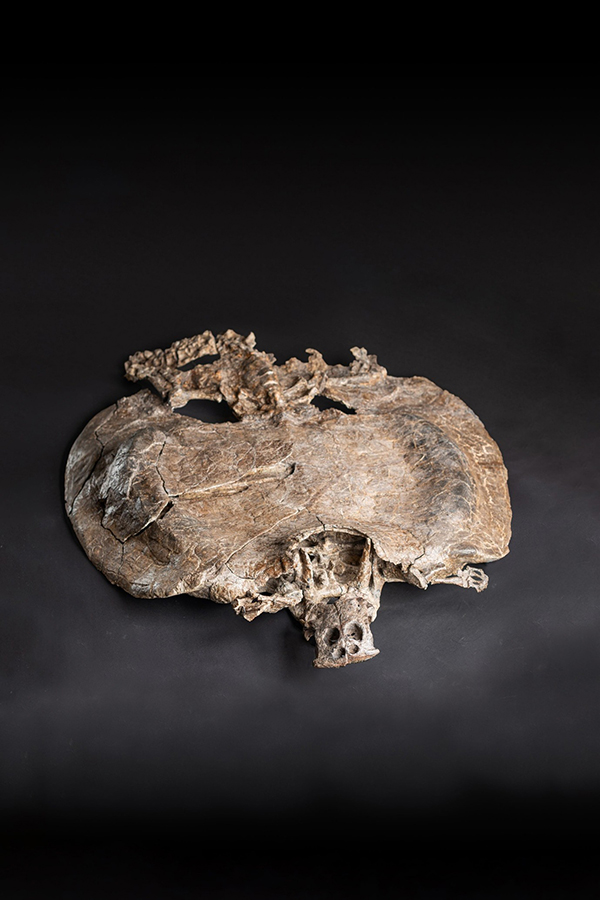
The Syrian find immediately brings to mind a globally unique animal found in Tübingen, which can be seen here in the University’s Palaeontological Museum: Henodus chelyops, or “turtle-like single-tooth”. Palaeontologists refer to it as the “Tübingen world sensation”. Since 1934, three excavation campaigns on the steep slope of the Goldersbach stream in Tübingen-Lustnau have unearthed a total of eight specimens, the only ones in the world. Related species have only been found in Portugal and Spain.
The first description was made by the famous Tübingen palaeontologist Friedrich von Huene. The animal was about one metre in size and resembles a sea turtle due to its broad, flattened body, but belongs to the marine placodonts. In evolutionary theory, this is referred to as “convergent evolution”, meaning the independent development of similar characteristics in unrelated species due to similar environmental conditions. The strong armour protected both species from predators, which in the time of Henodus were particularly large predatory dinosaurs. Henodus chelyops had only four paving-stone-like teeth (one in each jaw wing) and probably fed on small crabs and aquatic plants, which it sucked in with a water current as if through a filter and ground between its broad teeth. It probably lived in coastal lagoons or oxbow lakes.
The finds come from the Gypskeuper layer dating back 228 million years. At that time, large parts of southern Germany were covered by shallow inland seas and salt lagoons. Today’s Württemberg only developed into stable mainland around 65 million years ago as a result of uplift.
tun25090905