

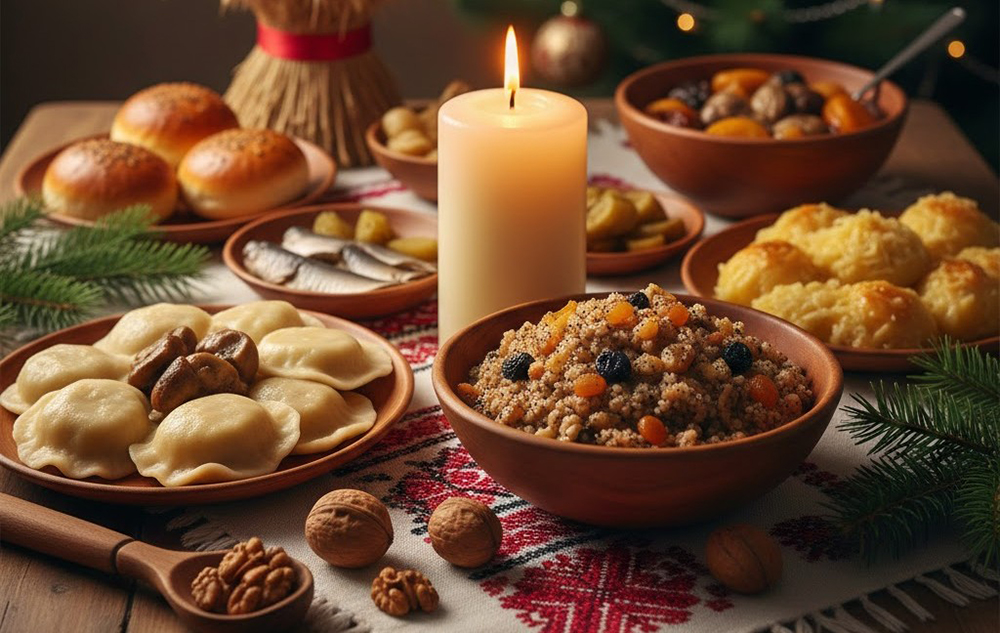
The Ukrainian winter holidays are not only a time of festive cheer, but also a period of togetherness, warmth and intergenerational cohesion. And although different peoples have their own unique characteristics, many Ukrainian traditions feature motifs that are also familiar to Germans: the quiet anticipation of Advent, the festive meal, the songs and the feeling of a new beginning.
Calendar change and the return to a common Christmas date
In 2023, the Orthodox Church of Ukraine and the Ukrainian Greek Catholic Church officially switched to the New Julian calendar. This means that Christmas is now celebrated on 25 December—together with most European countries.
In fact, this date was historically a matter of course for Ukraine: until 1917, 25 December was listed as Christmas Day in old calendars. It was only after the Soviet occupation that the Ukrainian territories were artificially switched to 7 January. Today’s return is therefore not a reinvention, but the restoration of an interrupted tradition.
Lent and preparation
Christmas is preceded by Lent—a period of restraint, inner order and expectant waiting. It is similar to the German Advent, only without sweets and mulled wine. Lent ends with Christmas Eve, the meaning of which lies not in abundance, but in the value of spending the evening together. Twelve traditional meatless dishes are served. They symbolise not only the twelve apostles, but also a prosperity that does not depend on expensive products. The menu varies depending on the region, but the following dishes are always essential: kutia, dried fruit compote (usvar), varenyky, fish, mushroom dishes and stuffed cabbage rolls with grain.
Kolyadky and Shchedrivky
Foreigners often confuse these two types of Ukrainian festive songs. Kolyadky are sung during the Christmas season—from 25 December to 6 January. They tell of the birth of Jesus, biblical motifs and praise light and goodness. Shchedrivky are sung at a different time—on Old New Year’s Eve, on the night of 14 January. Their themes are quite different: wishes for a good harvest, prosperity, joy and abundance. One of the Shchedrivky is the world-famous “Shchedryk” by Mykola Leontovych, known internationally as “Carol of the Bells”.
Traditions that unite
As in Germany, the celebrations in Ukraine begin long before Christmas: People prepare their homes, light candles and gather the family. For children, this is a time of adventure: going from house to house, singing, wishing good luck—and receiving sweets or small gifts in return. And although the forms differ, the essence remains the same: joy, hospitality, light in the home and the desire to share this light with others.
Classic recipe for Chernihiv kutia by the author
A simple, traditional recipe—just as it has been prepared for decades in the northern Ukrainian region of Sivershchyna.
Ingredients:
1 cup of hulled wheat, ½ cup of poppy seeds, 3–4 tablespoons of honey, a handful of walnuts, a handful of raisins (optional), usvar or boiled water to achieve the desired consistency.
Preparation:
Wash the wheat, soak for several hours and then cook until soft. Pour boiling water over the poppy seeds, strain and rub into a light poppy seed paste. Lightly toast the walnuts and chop finely. Dissolve the honey in warm usvar or water. Mix everything together: wheat, poppy seeds, nuts, raisins and the sweet liquid. Leave to infuse. Kutya tastes best the next day.
By Oleksandr Maishev
tun25111106