

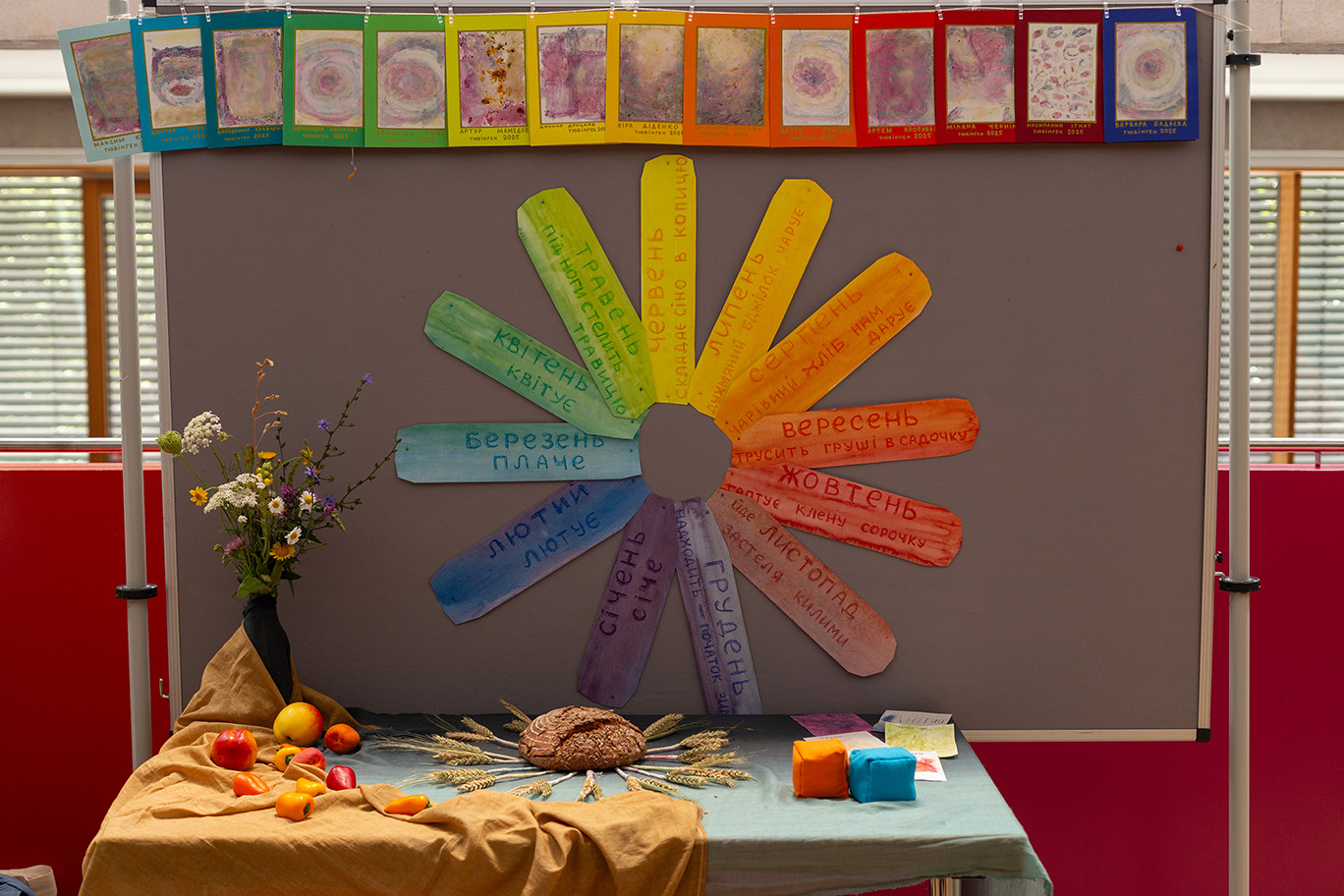
Every Saturday shortly after 9 a.m., Ukrainian can be heard in Uhland-Gymnasium. This is where the Ukrainian School holds its classes for children and teenagers from Tübingen and the surrounding area.
At exactly 9 a.m., silence still fills the corridor of the building on Uhlandstraße. Students and teachers observe a minute of silence in memory of those who gave their lives for Ukraine. “We continue the tradition of honoring people who gave their lives for Ukraine.” In this way, children learn “to feel connected to what is happening in Ukraine,” says Nataliia Skybak, founder of the Ukrainian School in Tübingen.
How it all began
The Ukrainian School in Tübingen was founded on July 13, 2024. According to Skybak, the idea arose out of necessity. Questions kept appearing in Ukrainian community messenger groups: where children could learn Ukrainian, how they could stay connected to Ukraine, and how the language could be preserved.
Skybak had experience in project work and knew how to formally establish such an initiative. She submitted a project proposal to the City of Tübingen office responsible for equality and integration and collected signatures in support. At the same time, Oksana Ukrainets joined the project and helped with communication and organization, including the initial contact with the school administration so that classes could take place here, near the main train station. For families travelling in from surrounding towns, this is crucial: the shorter the trip, the more likely it is that children will continue attending the additional Saturday school.
Funding from the city and parents’ contributions
The city supported the project with €5,000 for the previous school year and another €5,000 for the current one. That is not enough, so additional parental contributions were introduced: €10 per child per month last year and €15 in the current school year. The school currently has 80 pupils. Classes on Saturdays run from 9:00 a.m. to 1:30 p.m., with each lesson lasting 45 minutes.
Parents who enroll a child receive a short document with the school’s rules. It mainly covers respectful behaviour, regular attendance, parental responsibility, and organizational matters such as how and where the fee should be transferred.
Five subjects in one morning — plus German
Every Saturday, five subjects are taught: Ukrainian language, Ukrainian literature, the history of Ukraine, and ethnology and music on an alternating basis. Ethnology is taught by the school’s founder, Nataliia Skybak. German is also on the timetable and is taught by Ukrainian philologists.
There is a practical reason for this. Many children who came to Germany because of the war started out in integration classes, often without systematic instruction. This creates gaps that become noticeable later in mainstream schooling, from understanding assignments to writing.
The school in Tübingen works differently from schools in Ukraine. “We bought textbooks for the teachers, but sometimes we also work digitally. We cannot replace in one day a curriculum that children in Ukraine cover over five days a week. That is why we select the most important aspects,” says the school’s founder. Teachers prepare materials, print worksheets, create presentations, and provide additional material for watching, listening, and working on online.
Five groups, from “Sunbeams” to “Eaglets”
Because resources are limited, the school has five groups with roughly a two-year age difference between them. The youngest are called “Prominchyky” (“Sunbeams,” ages 5–6); on Saturdays they have only three lessons. Then come “Solovejky” (“Nightingales,” ages 7–8), “Zhuravlyky” (“Cranes,” ages 9–10), “Sokoliata” (“Falcon chicks,” ages 11–12), and “Orliata” (“Eaglets,” ages 13+). These names were chosen deliberately. The group names are symbolic, and each reflects certain age-specific characteristics of the children. Only the youngest are called “Sunbeams” because, as Skybak explains, “their eyes shine.”
Breaks last from 10 to 15 minutes. Every Saturday, two parents take turns supervising, making sure everything stays orderly in the corridors and in the inner courtyard. For the school, this is a matter of safety and responsibility — and a sign that it is built on shared participation.
Not to catch up on the curriculum, but to provide support
“The main mission of our school is the harmonious development of all Ukrainian children who have found themselves in Tübingen and the region,” says the founder. No one can fully convey academic knowledge in 45 minutes once a week. The point lies elsewhere: “We awaken a love for the Ukrainian language, literature, history, ethnology, and for knowing one’s roots and traditions. How can you love something if you do not know it?” Through this knowledge, children and teenagers learn to love and respect themselves — and as a result, they feel more confident in German society. The school also creates a Ukrainian community.
Between two languages and two systems
Within this community, children talk to one another about life between two languages and two systems — about language barriers, the feeling of being different, and the stress of German school. “Then children understand: I’m not the only one, I’m not alone. This should not be silenced — it has to be talked about. We need to support one another and help our children become confident and grow right here where they are, without forgetting who they are,” she adds.
The strength of that sense of community is also reflected in children’s answers when asked why they attend the Ukrainian School. “Sometimes on Saturday morning I don’t feel like getting up for school. But when I remember that my friends will be there, I feel happier right away. Then I get ready quickly and go to school with joy,” one child wrote.
Motivation instead of pressure, and creative activities
There are no traditional grades in the Saturday school, unlike in Ukraine or Germany. In the younger groups, teachers rely heavily on praise and small tokens of recognition. In the older groups, learning progress is partly recorded internally to keep track of pupils’ development, and at the end of the month especially active children are highlighted in the group. There are no exams as such. Homework is either not given at all or only very rarely, more as a recommendation, for example to read at home or revise certain things. The goal is motivation, not additional pressure after an already demanding school week.
In addition to lessons, the school also organizes events. At Christmas, the children staged a vertep nativity play, and the city provided a hall for it. “The children enjoy performing on stage; they love singing carols,” says the founder.
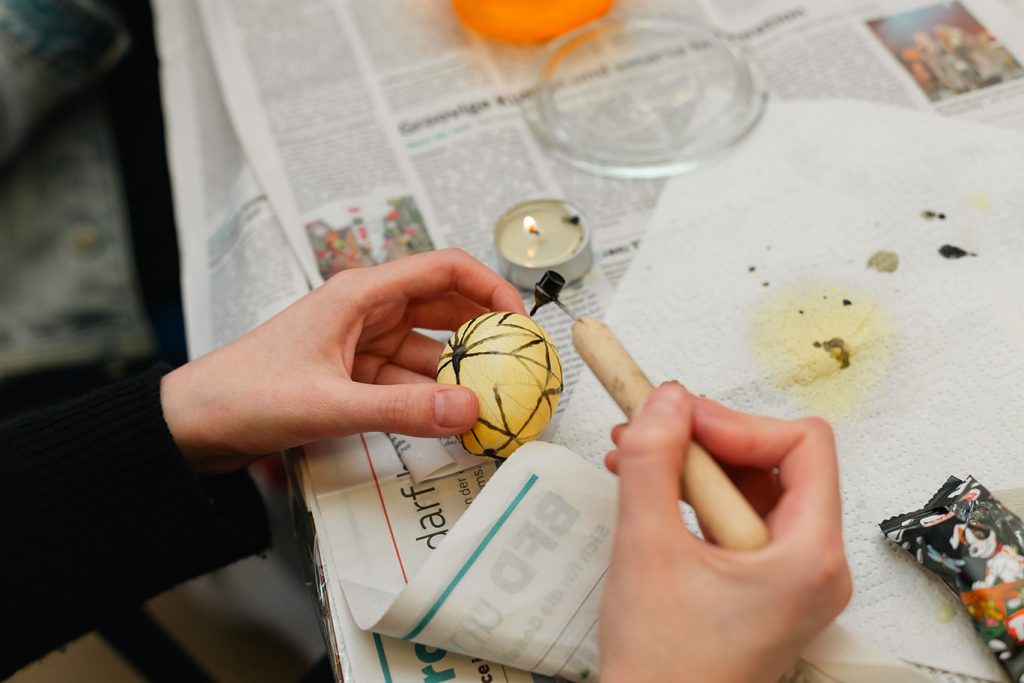
Ahead of Easter, a workshop on pysanka-making is planned — the traditional technique of decorating Easter eggs with wax and dyes — with separate sessions for children and parents. The school provides materials such as kistkas, wax, and dyes; participants bring the eggs.
One particularly memorable workshop focused on braiding hair. Olena, the grandmother of one of the pupils, who previously taught hairdressing, spoke to children and parents about hair care, demonstrated braiding techniques including weaving in ribbons, and showed simple hairstyles — “basic, but very important practical things,” as Skybak puts it. Parents have also initiated other creative activities, including clay modelling, painting various objects, and making beaded jewellery.
The biggest challenge: finding teachers
Eight teachers work at the school. According to Skybak, the biggest personal challenge was finding the right staff. The search was carried out everywhere — in Ukrainian messenger groups, through German acquaintances, through the Jobcenter, and through personal contacts. Not everyone who initially agreed stayed; working with groups at different levels of preparation is difficult.
Important support came from the university community. Olena Saikovska from the Department of Slavic Studies at the University of Tübingen helped find two students who now teach Ukrainian.
Who is Nataliia Skybak?
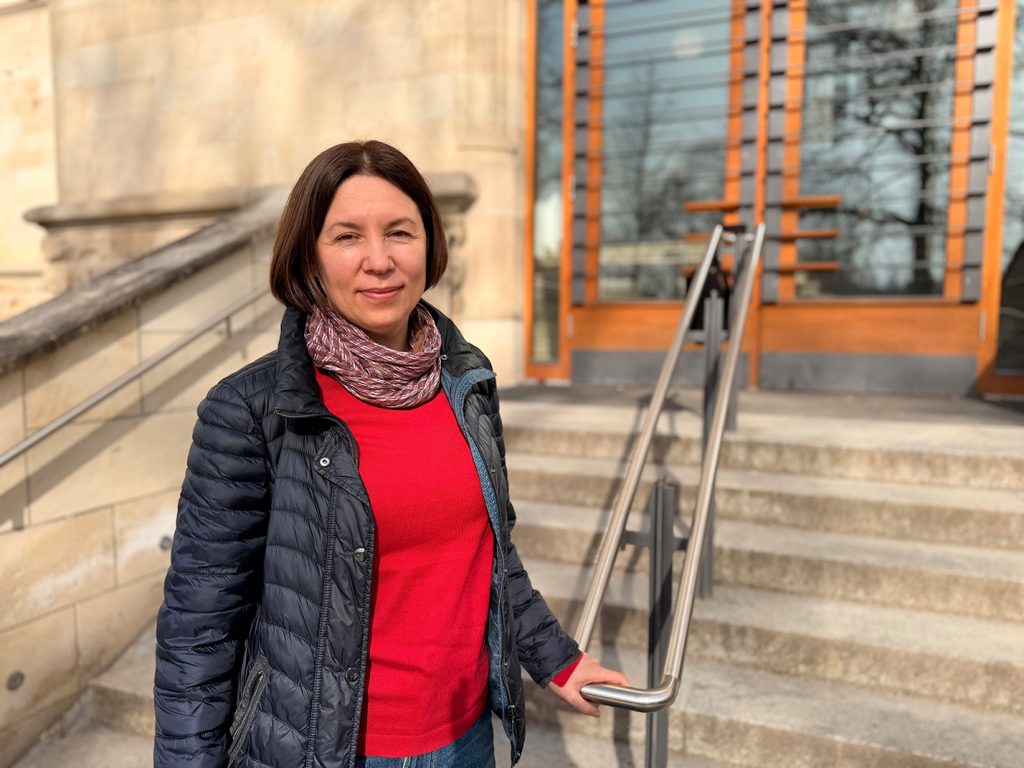
Nataliia Skybak comes from the western Ukrainian city of Truskavets. By training, she is both a historian-ethnologist and an economist specializing in banking. She worked in a bank for 11 years and then spent 6.5 years in urban development as head of the Department for the Development of the City of Truskavets. She arrived in Tübingen in February 2023. Today, she works in the city administration’s social assistance department. Her responsibilities include matters related to housing provided by the city.
Skybak lives in Tübingen with her younger daughter, who also attends the Ukrainian School. Her older daughter studies in Kyiv and remains there despite regular attacks, major problems with electricity and heating, and frequent interruptions in the water supply.
The founder does not want the school to remain a short-term project. “I would very much like studying here to be considered prestigious — for children and parents to want to come here willingly,” Skybak says. “That is possible only through results and through the fact that children love the school and take part in shaping it.” After all, the school is built collectively by teachers, parents, and children.
Roots as support in a time of change
Another important point for Skybak is this: “It is impossible to understand what is happening to your country today if you do not know what came before. The world is complex, and this is a time of great change. To endure, you need roots,” she says. At the Ukrainian Saturday school in Tübingen, the foundations for this are laid every Saturday at 9 a.m. — first through silence, then through language and community. For many families, it is something more than just lessons.
To enroll a child in the school, families can contact the school by email at: ukrschuletuebingen.de@gmail.com
More information is available on the Ukrainian School in Tübingen’s
Facebook page.
tun26032701