

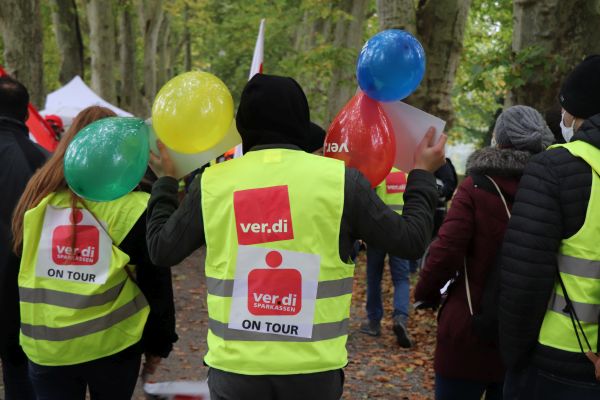
Trade unions are important organisations in Germany that campaign for the rights and interests of employees. Their goal: good wages, fair working conditions and social security for everyone who works.
The state does not interfere
What is special about the German system is that employers’ associations and trade unions negotiate collective agreements on their own responsibility—i.e. agreements on wages, working hours, holidays and other important issues. The state does not interfere in this process. This principle is known as collective bargaining autonomy. Trade unions can call strikes to enforce the interests of employees. In addition to strike pay, trade unions offer their members free legal advice and legal protection in matters of labour and social law.
DGB represents eight trade unions
The largest umbrella organisation in Germany is the German Trade Union Confederation (DGB). It represents around 5.7 million members. It comprises eight individual trade unions such as ver.di, IG Metall and the Education and Science Union (GEW). There are also other organisations such as the Civil Servants’ Association (dbb) and smaller Christian trade unions. DGB | The DGB
Influence on social issues
Although fewer people are members of a trade union today than a few decades ago—a good 13 per cent of employees—their influence remains strong. Trade unions also get involved in important social issues, such as the minimum wage, fair working conditions in the context of digitalisation, and the social impact of the energy transition. Hans Böckler Foundation | Trade unions
Co-determination in companies
In addition, employees can have a say in what happens in the company through works councils—for example, in shift schedules, further training or social issues. This is regulated by the Works Constitution Act. This gives employees co-determination rights. Federal Ministry of Labour and Social Affairs | Co-determination in companies).
See also tun24013102
tun25052008