

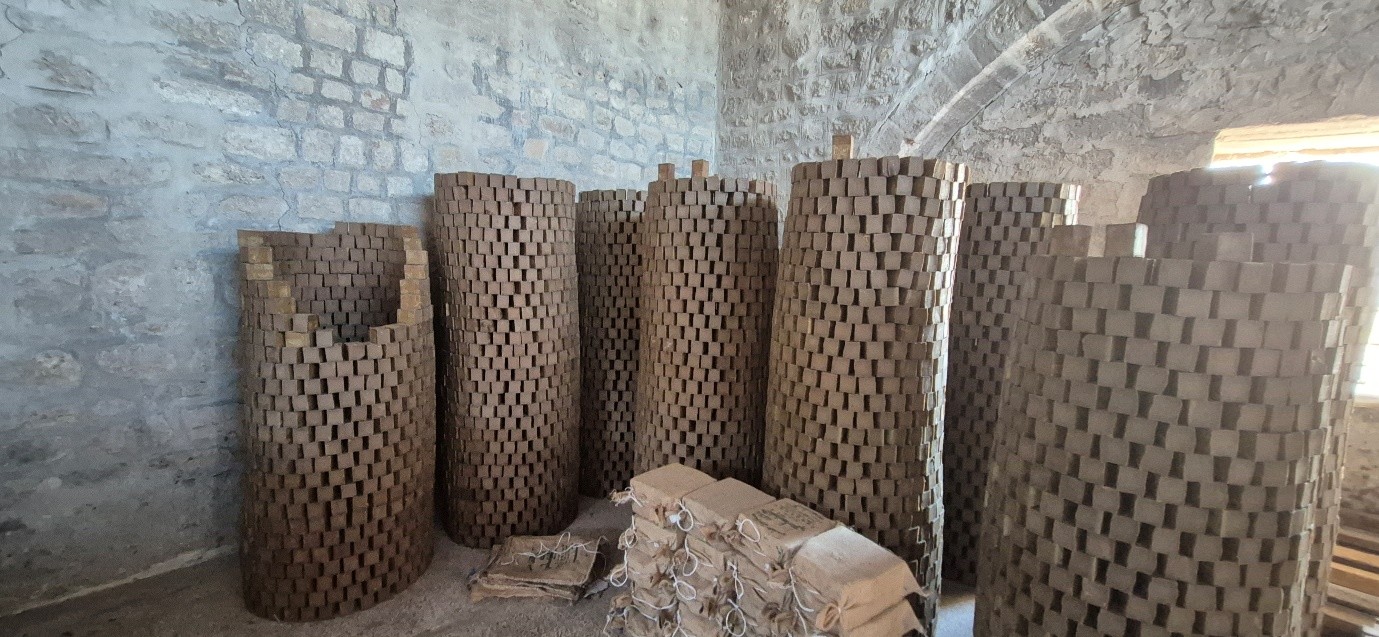
Aleppo soap is not merely a cleaning product, but an integral part of the identity and artisanal heritage of the city of Aleppo. Its production dates back hundreds of years. The knowledge and skills have been—and continue to be—passed down from generation to generation. Its production is a traditional family craft. The Old City of Aleppo is still home to the oldest workshops where the soap is produced using traditional methods. Since 2024, the craft of Aleppo soap-making has been included on UNESCO’s List of Intangible Cultural Heritage.
The History of Soap Making
According to reports from merchants in Aleppo, the production of laurel soap began in the city more than 1,000 years ago, though there is no archaeological evidence to support this. At that time, it was carried out by a few families in their homes in the Old City. It is believed that these families discovered, in some way, that soap made from oils could be used for cleaning. The soap was sold directly in the old markets. As demand grew, production expanded, and dedicated workshops were established.
About 800 years ago, an area in the southwest of the city, near Bab Qansarin, was designated for production facilities. Although the production facilities were located among residential buildings, the residents welcomed their proximity, as pleasant scents wafted through the air during the manufacturing process. Currently, there are dozens of shops in the city of Aleppo that specialize in selling soap. Their operations are not limited to the local market but also include wholesale distribution to various regions of Syria as well as sales in international markets.
Soap factories are spread over two floors
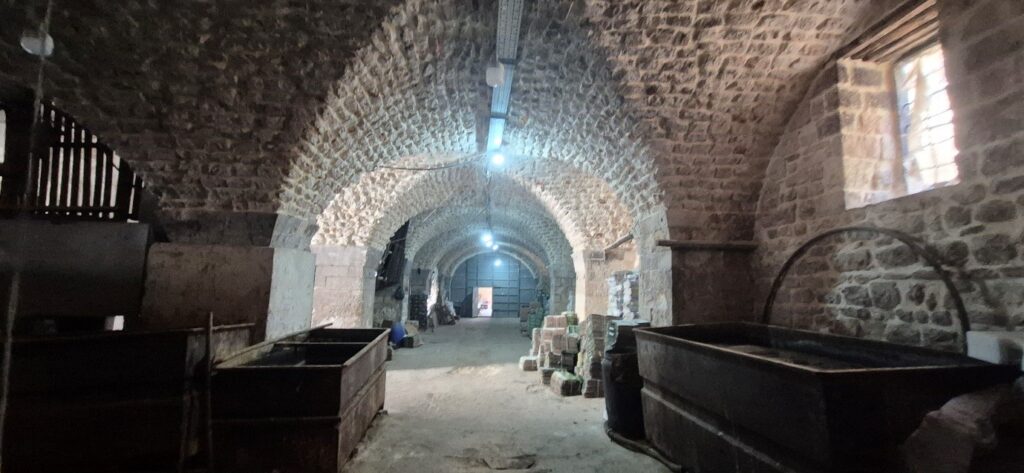
The soap factory in Aleppo is called a “masbana.” It is a spacious facility equipped for all stages of production. Typically, the masbana is divided into three main areas corresponding to the key production steps. The ground floor is used for processing the four raw materials, mixing them, and heating the soap mixture to approximately 150 degrees Celsius. This step is carried out under the supervision of an experienced specialist who learned the craft within the family. The first floor, on the other hand, is reserved for drying and curing the soap. This requires a lot of space; at the same time, this floor serves as a storage area. It is usually partially open on several sides.
A family business with a centuries-old tradition
tuenews INTERNATIONAL visited the Al-Jabali soap factory and met with the employees as well as Hisham Al-Jabali, the factory’s owner. The facility looks back on a history of about 800 years. It is named after the Al-Jabali family, which has been operating at this location for six consecutive generations—that is, for at least 300 years. At the entrance to the building, there are also 30 cisterns made of stone and lead for storing olive oil. They serve to safely store the oil and prevent it from leaking.
Production is done entirely by hand
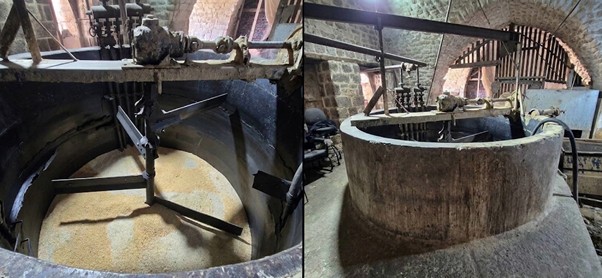
The production process consists of six steps and takes more than six months. Production is still carried out entirely by hand, using only plant-based raw materials. The production of Aleppo soap begins with the preparation of olive oil and laurel oil. The oils are then boiled in large copper pots using traditional methods, together with water and a lye solution. The mixture is stirred for hours until the oils transform into a soap mass.
A Seal as a Family Trademark
Once the saponification process is complete, the soap is rinsed several times with water. The soap paste is then spread out on a very large, smooth marble surface and left to stand until it has cooled and hardened. It is then cut into pieces and stamped by hand with the family seal. The family name on the soap is of great importance. Each family has its own seal, which it applies to every bar of soap immediately after production. The seal serves as the family’s trademark. Within two hours, 3,000 bars of soap were stamped by hand.
The soaps are stacked into towers to cure
The bars of soap are then stacked in special, air-permeable towers inside the workshops, where they remain for several months—between six months and a year. The soap needs this time to dry and mature until it reaches its characteristic quality and color. The longer the soap is allowed to mature undisturbed, the better its quality becomes, and the longer it can be stored. During this period, the soap’s color also changes: the interior remains green, while the outer layer gradually turns brown due to contact with air—much like the leaves of a tree. This color change is one of the characteristic features of traditional Aleppo soap.
Cutting the soap requires a great deal of effort
The soap is cut into pieces by hand and quickly. This is a labor-intensive process. A handmade wooden device is used, consisting of two parts for clamping and pressing. The workers also wear wooden shoes. After the green soap mass has been rolled out, it is left to rest for a day so that it hardens slightly. Next, several people pull on the wooden device—which includes a plow-like part—while a child stands on it to apply pressure to the soap mixture. This cuts it into uniform pieces. Stamping follows immediately afterward. The cutting is done in two directions: lengthwise and crosswise.
Production takes place in winter according to a secret recipe
The traditional production of Aleppo soap takes place exclusively in winter, as low outdoor temperatures are required for this process and the necessary raw materials are only available after the olive harvest. Production occurs in several batches. The process is supervised by an experienced artisan, known as the “Al-Musabnaji.” A man learns his craft from his father and grandfather and then passes it on to his sons and grandsons. The composition and proportions of the soap mixture remain a secret; they are passed down orally within the family and have never been recorded in writing. Although Aleppo soap is now known worldwide, its traditional production is still primarily maintained by certain families from Aleppo.
An Integral Part of Cultural Identity
Aleppo laurel soap is rich in symbolism and profound meanings. It is an inseparable part of the cultural identity of the city’s residents and their collective memory. Furthermore, it is closely linked to the families of Aleppo who have passed down this craft across generations and, in some cases, have even continued it in the very same location. Its significance is not limited to daily use but also extends to the social relationships between the people of Aleppo and their acquaintances in Syria and beyond. Furthermore, it is closely linked to the six families from Aleppo who have passed down this craft through generations and, in some cases, have even continued to practice it in the same location in the heart of the Old City.
A Fragrant Testimony to Generosity
Laurel soap is considered one of the most significant gifts that express Aleppo’s identity, its history, and the generosity of its inhabitants. The people of Aleppo take it as a gift when they visit friends outside the city, and they have also introduced it to their new homelands in various parts of the world. In addition to using it to wash their hands and bodies, Aleppans typically place a bar of soap in their closets to give them a pleasant scent. I, too, always keep a bar of it next to me on my desk.
Popular Worldwide, Especially in Germany
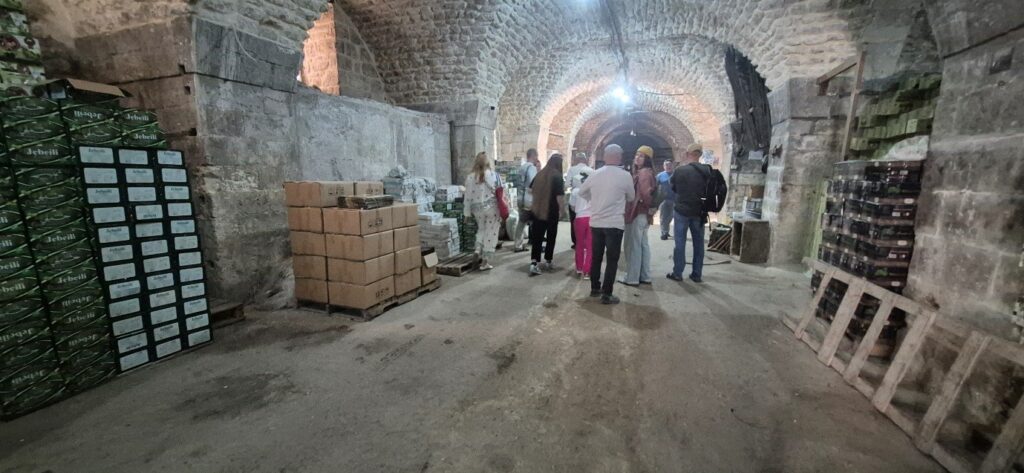
Aleppo soap has spread worldwide thanks to its historical reputation, quality, and natural ingredients. It has now become one of the traditional Syrian products that are gaining increasing attention in European markets. Germany is one of the most important markets where this soap is available. It is sold in numerous cosmetics and skincare stores, as well as in specialty shops for natural and Middle Eastern products. The growing interest in natural care products, as well as the presence of Syrian and Arab communities, has helped strengthen its significance in the German market.
Laurel Soap as Cultural Heritage Worth Protecting
The production of Aleppo soap is not only a traditional craft for making a consumer good but also a living testament to the history and artisanal traditions of the city of Aleppo. It preserves traditional knowledge, specialized skills, and experience that have been passed down through generations. Preserving this craftsmanship therefore means not only protecting a traditional product but also safeguarding the knowledge and skills of the families and artisans who continue this tradition to this day.
Further information:
https://www.youtube.com/watch?v=Sk7brX9dloE
https://www.srf.ch/play/tv/srf-news-videos/video/seifenfabrik-trotz-krieg-und-sanktionen?urn=urn:srf:video:b7133e7a-0b7a-4995-a675-11fb93a73200
https://www.spiegel.de/ausland/syrien-traditionelle-seifenherstellung-in-aleppo-trotzt-dem-buergerkrieg-a-999ac755-5d4a-42e6-8399-fd227c3926d4
tun26080508