

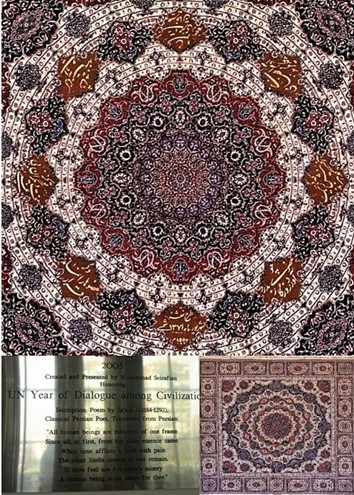
In the United Nations Conference Building in New York hangs a 5-meter-by-5-meter carpet bearing the famous poem “Bani Adam” (The Children of Adam) by the Persian mystic Saadi Shirazi:
“Human beings (the Children of Adam) are members of a single body; for they were created from the same essence. If fate strikes one member with pain, the others find no rest. Whoever accepts the suffering of others with indifference does not deserve to be called human,” according to the translation into German prose.
Saadi: A Poet and Traveler of Great Influence
Saadi Shirazi (c. 1210–1291/1292) is considered one of the most important figures in classical Persian literature. He was born in Shiraz in present-day Iran. He studied Islamic jurisprudence and other religious disciplines at the Nizamiyya Madrasa in Baghdad. Throughout his life, Saadi undertook extensive travels through various regions of the Middle East and beyond. His works contain references to Iraq, Syria, Palestine, Mecca, Egypt, and Anatolia. An episode in his magnum opus, *Golestan* (The Rose Garden), recounts his capture by European crusaders in Syria and his subsequent forced labor.
His texts contain numerous accounts of encounters with people of diverse backgrounds and social standing. Central themes include ethics, justice, compassion, human behavior, and social responsibility.
Saadi’s works have also been disseminated in European languages since the 17th century. Translations and adaptations of his works have also appeared in German-speaking countries. Goethe studied Persian literature and was familiar with Saadi’s writings. According to recent research, Saadi, alongside Hafiz, was one of the most important sources of inspiration for Goethe’s exploration of Islam and the Orient in the *West-Eastern Divan*.
A Story in Damascus
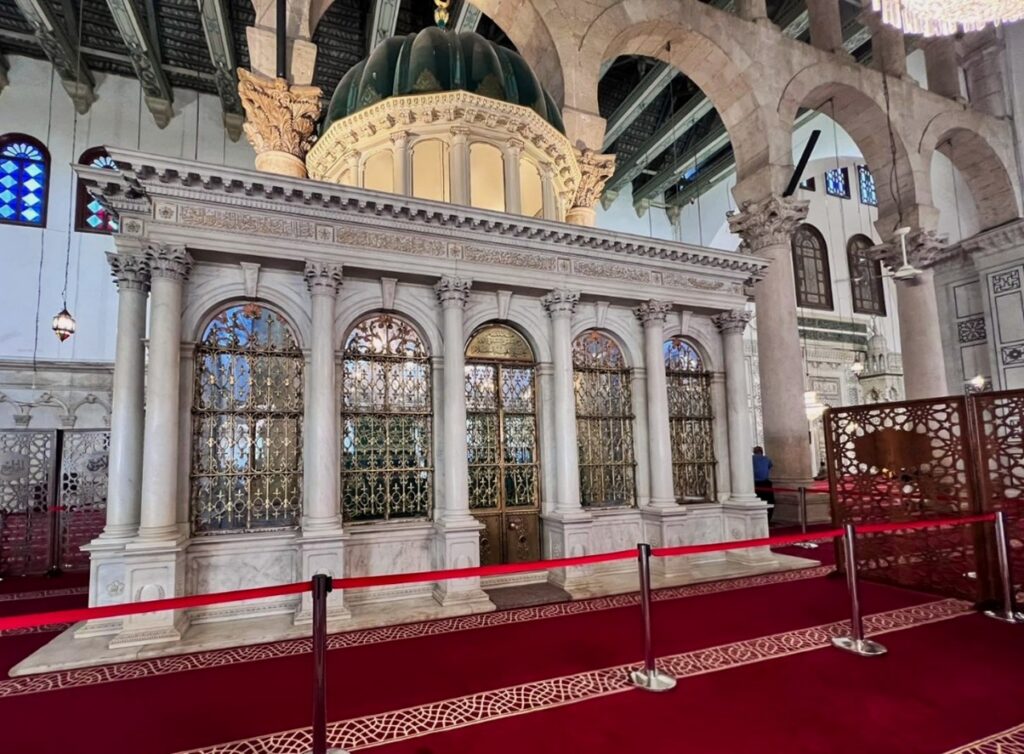
The context for the poem “Bani Adam” is the tenth tale in Chapter 1 of the *Golestan*, in which Saadi describes how he knelt beside an Arab king at the tomb of John the Baptist in the Umayyad Mosque in Damascus. John is regarded as a prophet in Islam. There used to be a Byzantine church in front of the mosque; to this day, Muslim and Christian pilgrims visit the preserved tomb. This king was known for his injustice and asked Saadi for good wishes and intercession because he feared his enemies. According to tradition, Saadi said to him: “Show mercy to your subjects, who cannot defend themselves against you, and then you need not fear harm even from a powerful enemy!” The poem then follows.
Saadi’s Predecessors?
Saadi’s poem is occasionally viewed as an early plea for universal human rights. However, the historical context is entirely different from that of the emergence of human rights in the modern era since the 18th century. Religious precedents can be found, for example, in a statement by Paul in the Epistle to the Galatians in the 1st century: “There is neither Jew nor Greek, neither slave nor free, neither male nor female; for you are all one.” Even greater is the similarity to a hadith, a traditional saying of the Prophet Muhammad: “The believers are like a single body in their affection, mercy, and compassion for one another. When one part of it suffers, the whole body reacts with sleeplessness and fever.” [Ṣaḥīḥ Muslim, Chapter 44 / Hadith No. 22 (4685)]
“The Children of Adam” and the United Nations
Kofi Annan, the former Secretary-General of the United Nations, is said to have been present at the handover of the carpet to the UN and to have delivered a welcoming address. The poem on the carpet may have inspired him to utter his famous phrase during his welcome address at the 2009 World Summit in New York: “We stand or fall together.” In doing so, he extended the image of the unity of all people to the unity of nations within the global community.
The official occasion for the presentation of the carpet in 2005 as an Iranian state gift was the “Year of Dialogue among Civilizations” (2001), proclaimed by the United Nations. The famous Iranian carpet artist Mohammad Seirafian from Isfahan created and donated the gift.
As early as 1928, the Albanian delegate Mehdi Frashëri is said to have proposed using Saadi’s “Bani Adam” as the motto of the League of Nations. However, the proposal was never implemented.
Further information:
Persian carpet | United Nations Gifts
‘We stand or fall together’ – Kofi Annan Foundation
tun26080510