

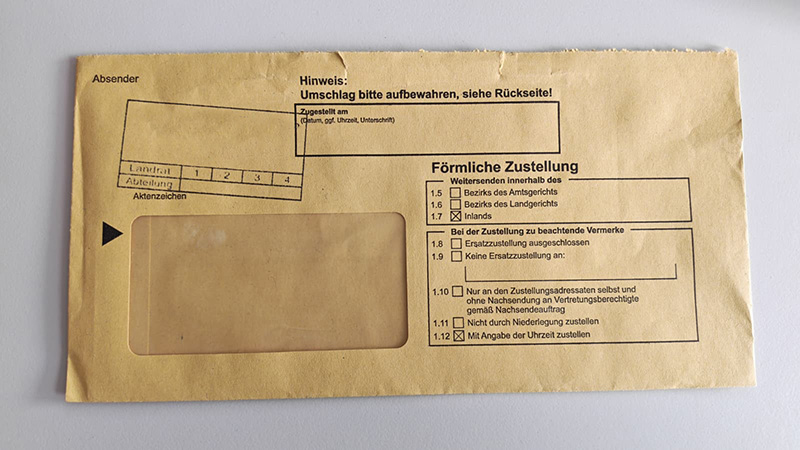
A debt collection letter should never be ignored. If you receive a court payment notice (Mahnbescheid), you must respond within the stated deadline. First, check who is demanding payment, what the claim is based on and whether the amount owed and any additional costs are justified. It is also important to distinguish between an ordinary letter from a debt collection agency and a Mahnbescheid issued by a court.
When Can a Debt Collection Claim Arise?
A claim may arise, for example, from an unpaid online order, a phone, internet, electricity or medical bill, a subscription that was not cancelled, a gym contract or a failed direct debit. After moving home, bills and reminders may also have continued to be sent to the old address for some time. However, some claims are based on errors, contracts that were not validly concluded, bills that have already been paid or misuse of personal data. If the amount remains unpaid, the creditor — the person or company to whom the money is owed — can apply to the competent court for a Mahnbescheid. A debt collection letter does not have to have been sent beforehand
Check the Claim Carefully
If you receive a claim from a debt collection agency, check whether you actually entered into the relevant contract or left a bill unpaid. The letter must state, among other things, the original creditor, the subject of the contract and the date on which the contract was concluded. Interest and debt collection fees (fees charged by the debt collection agency) should also be checked carefully. You can check free of charge whether a debt collection agency is officially registered in the Federal Office of Justice’s Legal Services Register (Rechtsdienstleistungsregister). However, registration does not automatically mean that a particular claim is justified.
If the claim is justified, it should be paid as soon as possible to avoid further costs. Even then, however, not all debt collection fees charged are necessarily lawful If the claim is wholly or partly unjustified, you should object to it in writing and inform both the debt collection agency and the original creditor. Keep a copy of the letter and proof that it was sent. Until the matter has been clarified, do not make partial payments or sign instalment agreements or other documents that you do not fully understand. A payment or signature may be interpreted as acknowledging the debt.
Mahnbescheid: You Have Two Weeks to Respond
You need to act particularly quickly if you receive a Mahnbescheid from a court. It is often delivered in a yellow envelope. The document does not mean that the court has already examined the claim in detail and found it to be justified. During the Mahnverfahren, the court initially checks only the formal requirements. If you believe the claim is unjustified, you must submit an objection in time for it to reach the court within two weeks of the Mahnbescheid being served. A special objection form is enclosed with the document. You can object to the entire claim or only part of it. If the claim is justified, it should be paid. An objection should not be submitted simply to gain more time to pay, as subsequent court proceedings may lead to additional costs. If you do not respond to the Mahnbescheid, you may later receive an enforcement order (Vollstreckungsbescheid). You can generally lodge an objection (Einspruch) within two weeks of it being served. If you still fail to respond in time, a bailiff may begin enforcement proceedings — even if the original claim was in fact unjustified.
Free Help Is Also Available in Ukrainian
For people who find it difficult to understand complex letters or legal terms in German, the German consumer advice service Verbraucherzentrale offers a free online Inkasso-Check. The service is also available in Ukrainian, Russian and Polish. It provides an initial assessment of whether the claim must be paid and whether the costs charged are reasonable. If you receive a letter from a court, face a short deadline or have a complicated case, you should contact Verbraucherzentrale or a lawyer as quickly as possible. Take the letter, the envelope, invoices, contracts and proof of payment with you to the consultation.
Further information:
Verbraucherzentrale: Inkasso-Check
Verbraucherzentrale: how to recognise dubious debt collection claims
Verbraucherzentrale: what to do if you receive a Mahnbescheid
Federal Office of Justice: Rechtsdienstleistungsregister
tun26090903