

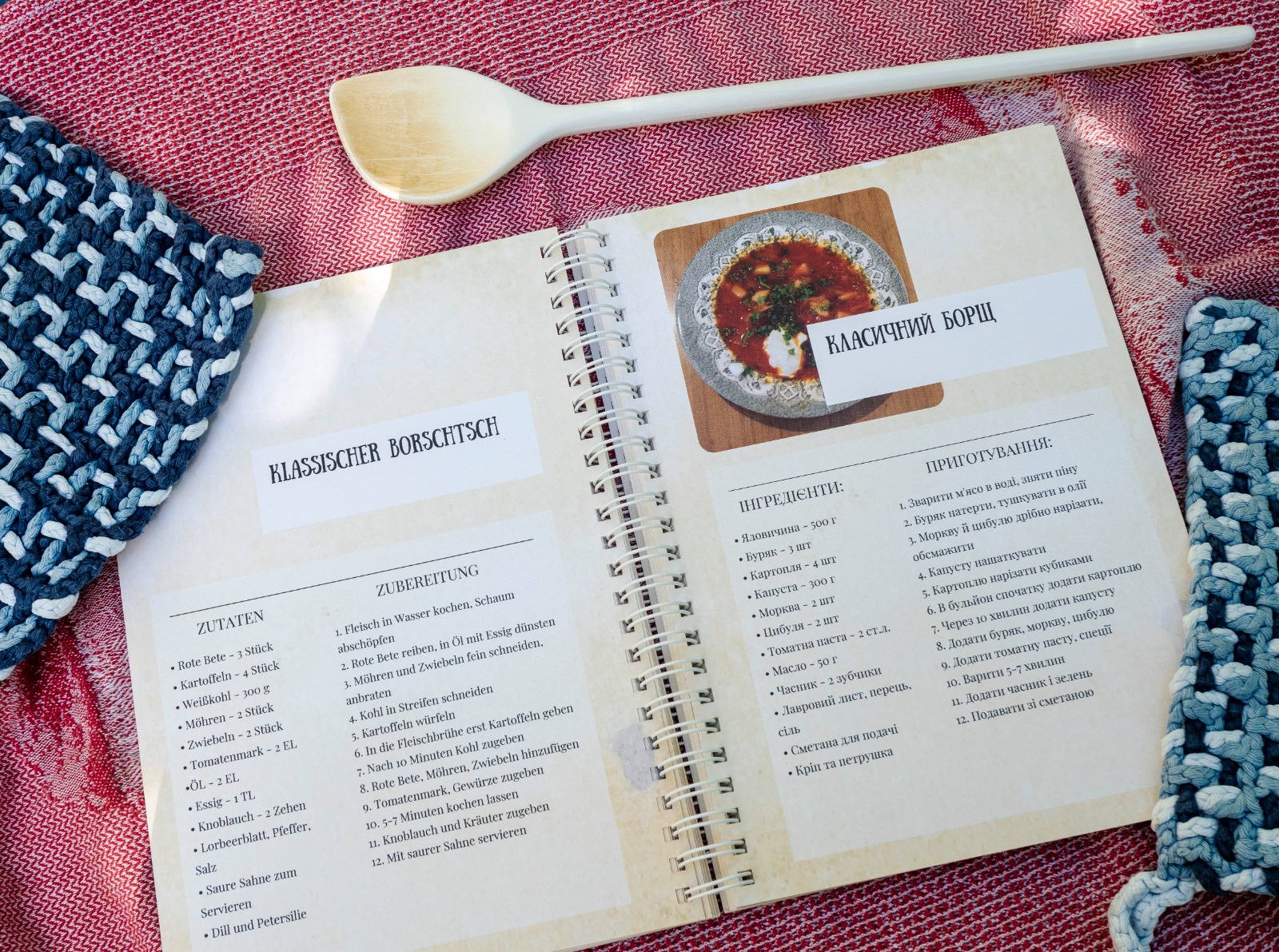
The answer comes instantly: ‘Borscht, of course.’ It was Lyudmila Boriak’s favourite recipe back in her native Kharkiv, and it remains so even after her escape, which brought her to Tübingen. The tradition of making Ukrainian borscht was added to UNESCO’s list of intangible cultural heritage in 2022. Borscht also holds a special place in the hearts of Lyudmila and her friends. This is how it found its way into the Ukrainian-German cookbook *Culinary Bridges*, created at the Brückenhaus in Tübingen as part of a German language course. The recipe for ‘classic borscht’ in German can be found on page 10, whilst the original Ukrainian version is on page 11. Next to it is a photo of a generously filled bowl of soup.
Helga Pflüger, who, together with Cornelia Schade and Babo Holme, offers free German language courses for Ukrainian women at the Brückenkurs, had had this idea for a long time. ‘The language of recipes is completely different from spoken language,’ explains the former teacher, who used to teach German, French and art. That is why she felt it was important to introduce her students to this aspect of the German language as well. But for the volunteer German teachers, it is not just about the language. From numerous conversations, they know what it means for female refugees to leave their former lives behind. “All that remains of their homeland for them are personal memories, the culture that shaped them, music, dances and songs, fairy tales, the cut and colours of their clothes, and the smells and tastes of their food,” the introduction states. That is why the German teachers asked their pupils time and again about traditional food: “What do you eat and when? How is it prepared?”

Dampfnudeln with garlic and dill
The recipes fill a 45-page cookbook. And since it also includes German recipes, it becomes clear that some dishes are not so different from one another after all. Ukrainian varenyky differ from their Swabian cousins, Maultaschen, primarily in their filling. The book features aspic, stuffed cabbage rolls and pumpkin porridge with bacon. Ukrainian cuisine features Dampfnudeln with garlic and dill, whilst a few pages further on, German Dampfnudeln without herbs are presented. Of course, there are sweet dishes too: syrniki and Fasnetsküchle. The teachers have also contributed their own recipes — for example, a yeast-free onion tart or apple strudel.
Valentyna Petrenko is particularly fond of varenyky with a cottage cheese filling. The doctor from Kherson was recently among the Ukrainian women who prepared around 2,000 varenyky for the Brunnenfest at the Wilhelmstift in Tübingen. She, too, misses Ukrainian cuisine and is delighted when her German friends ask her to cook something for celebrations or get-togethers.
Spätzle are a hit too
In the Brückenhaus kitchen, the cookbook team kneaded, fried, stewed and boiled. The participants rejoiced together when the recipes turned out well. The joy was mutual: ‘It’s a joy to meet these people,’ the cookbook states. Lyudmila has long since grown to love Spätzle too, she says with a laugh. “We have thin noodles in Ukraine too,” adds Valentina. Lyudmila, who used to work as a lecturer in inorganic chemistry at a university in Kharkiv, would like to try more German recipes. But in the small kitchen she shares with another woman, there isn’t enough space for large-scale cooking or shared meals.
It was a long journey from cooking together to the finished book. Many people were involved in turning the idea into a handy cookbook for everyday use, with a practical spiral binding. The publisher is Brückenhaus Tübingen — a community centre by the dam on the Neckar, operating under the auspices of the Tübingen Society for Social Therapy for Children and Young People e.V. (kit Jugendhilfe). Financial support was provided by the Ministry of Social Affairs in Stuttgart. Viktoria Konrad created the illustrations for individual sections, whilst Lise Holm designed the cover artwork. The text was proofread and translated from one language to another. Whilst compiling the cookbook, the Ukrainian women also learnt many new words: for example, ‘grater’, ‘sieve’ or ‘chopping board’. That is why a practical illustrated glossary has been included on the penultimate page. In addition, the book features a page on grammar — for example: ‘I mix’, ‘I mixed’, ‘I was mixing’ — and a page on adjectives from the world of cooking.
The cookbook is available in exchange for a donation at Brückenhaus. There are only a few copies left from the first and second print runs. Once the funding issue has been resolved, a third print run will be published.
Further information:
https://www.kit-jugendhilfe.de/angebote/brueckenhaus
https://www.brueckenhaus-tuebingen.de/
tun26052912