

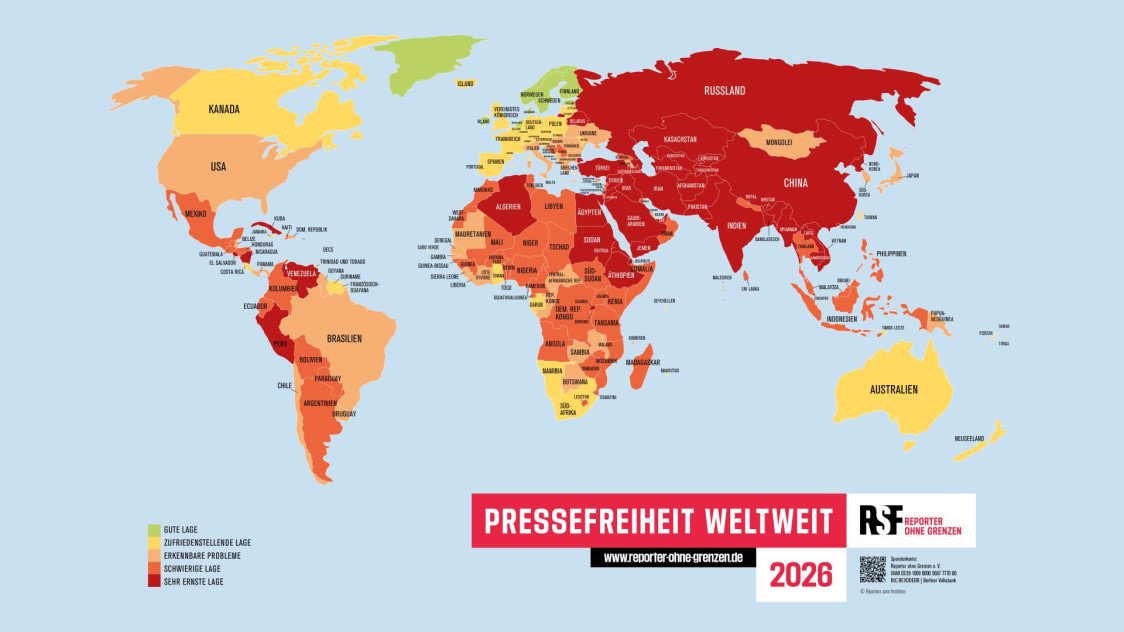
The picture is grim: in an increasing number of countries, media professionals are coming under ever greater pressure. Reporters Without Borders classifies the situation in 94 out of 180 countries worldwide as “difficult” or “very serious”. This is according to the organisation, founded 25 years ago, in its annual report on press freedom. Germany ranks 14th in the 2026 index. Until 2025, it was among the top ten.
There are reasons for Germany’s drop of three places. There, too, journalists face increasing threats in their work, whether on the ground or online – be it violence, hate or discrimination. This is fuelled by issues on which opinions differ greatly. “Particularly when reporting on far-right circles or the war in Gaza, many journalists speak of intense pressure, heated debates and the fear of being publicly pilloried,” says Christian Mihr, Director of Policy at Reporters Without Borders (RSF).
Wars and conflicts lead to decline
RSF reports that only one in 100 people worldwide can now access information through a diverse media landscape. RSF cites wars and armed conflicts as reasons for the decline in press freedom. Israel has dropped four places to 116th due to the Gaza war. Since October 2023, the Israeli army has killed more than 220 journalists in Gaza during attacks – at least 70 of them whilst on the job, writes RSF. The Palestinian Territories therefore rank 156th out of 180 countries or territories.
The second most dangerous region for media workers is Eastern Europe. Russia (ranked 172nd) “repeatedly and deliberately kills journalists” in its war of aggression against Ukraine. In Russia, as elsewhere in the world, journalism is being criminalised with increasing severity. According to RSF research, 48 media workers are currently in Russian prisons, 26 of them from Ukraine (ranked 55th).
Syria climbs 36 places
The biggest climber is Syria – from 177th to 141st place. Although the situation remains “very serious” following the fall of the Assad dictatorship in December 2024, Syria is catching up in terms of press freedom across all five indicators: safety, political context, legal framework, and economic and socio-cultural environment. Iraq, in 162nd place, and Afghanistan (175th place) are among the countries at the bottom of the ranking.
The top three places are held by Norway, the Netherlands and Estonia. The bottom three places are occupied by China, North Korea and Eritrea. However, RSF also classifies the situation as “very serious” in Iran (177th) and Turkey (163rd). Ukraine ranks just ahead of Italy (56th) and the USA (64th). In Africa, only two countries feature in the top 40: Namibia (23) and Ghana (38). The situation in all others is assessed as threatening to press freedom – particularly in Ethiopia (148th) and Eritrea, which ranks last for the third time at 180th.
Further information:
https://www.reporter-ohne-grenzen.de/rangliste/2026
and the full ranking
https://media.reporter-ohne-grenzen.de/production/6135/RSF-Rangliste-der-Pressefreiheit-2026-A4.pdf
tun26051502