

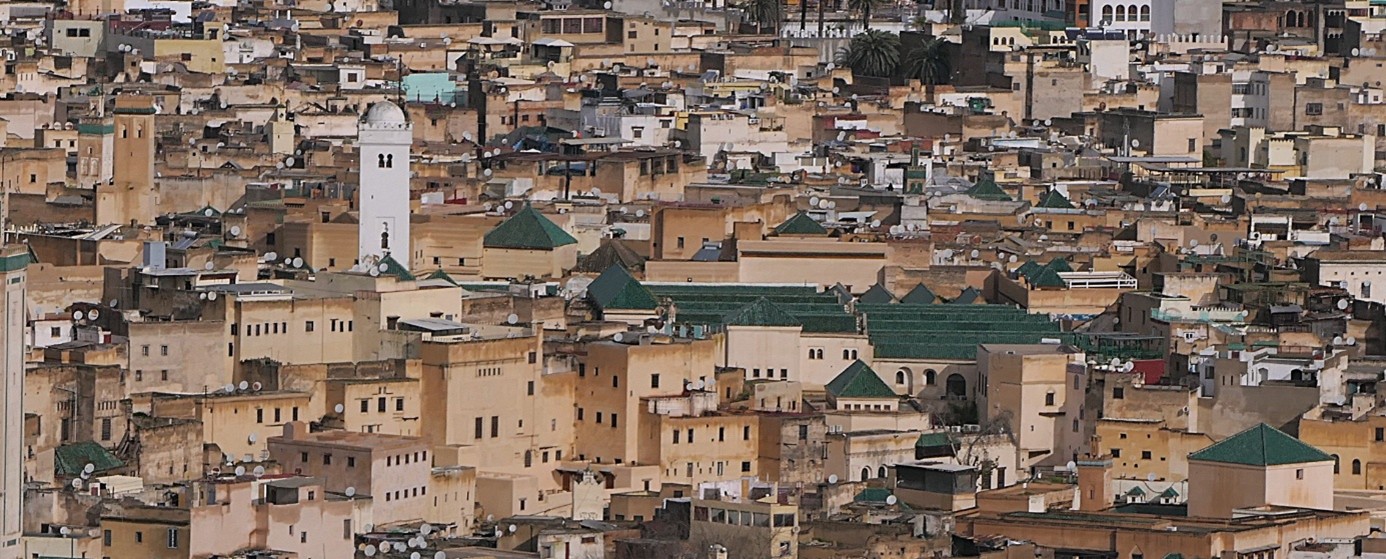
When it comes to the oldest universities, the names most often mentioned in Central Europe are – in this order – Bologna, Paris and Oxford. These universities began operating in the late 11th century or during the 12th century. An exact date of foundation cannot be determined due to the lack of reliable sources for this period. Hardly anyone knows that the university in the royal city of Fez in Morocco is considered the oldest in the world, founded more than two hundred years before the first European universities. At any rate, this is what is stated in the Guinness Book of Records and in UNESCO’s description of the Old City of Fez as a World Heritage Site.
Founded by a woman?
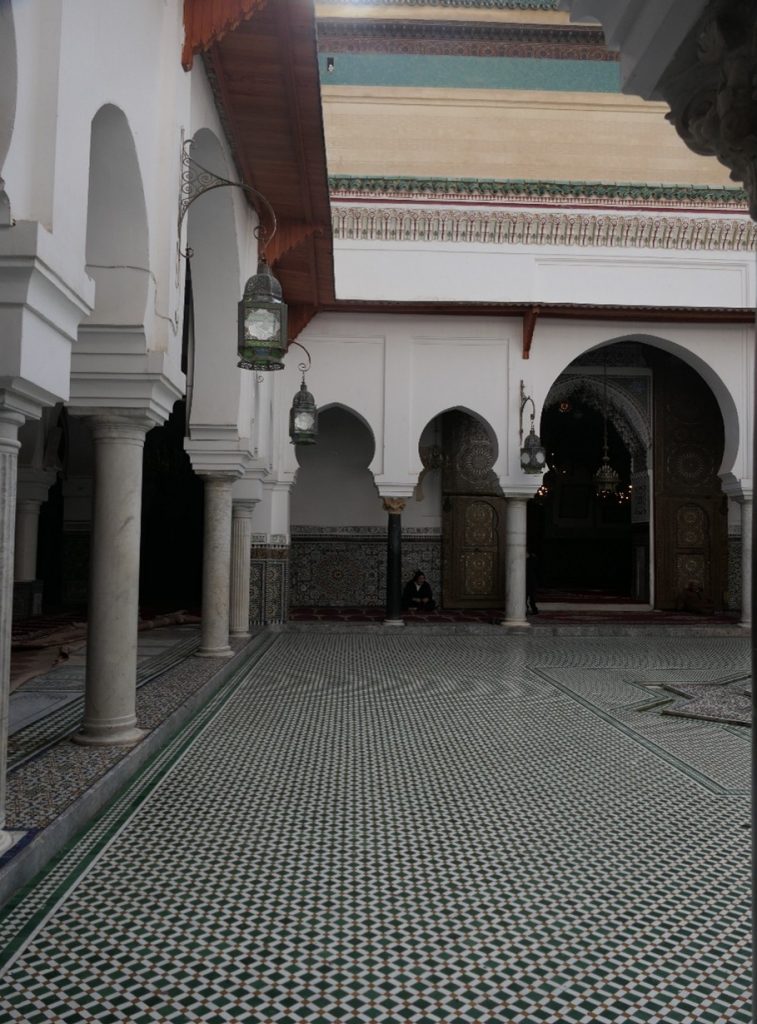
The story of its founding is based on a source from a 13th-century historian and makes for astonishing reading. According to this account, in 859, Fatima al-Fihri – who is said to have been a deeply devout woman – used her inheritance to build a mosque with an adjoining Koranic school (‘madrasa’) in the heart of the medina of Fez. She was the daughter of a wealthy merchant from Kairouan in Tunisia, who, like many others, emigrated to the Kingdom of Morocco. The mosque was named “al-Qarawyyin”, just like the migrants’ quarter, which means “the (people) from Kairouan”. This founding narrative is questioned by some modern historians, primarily because during renovation work in the 20th century, a painted-over inscription was discovered attributing the mosque’s foundation to a son of the then-reigning King Idris II.
From Koranic school to university
It is also unclear exactly when the Koranic school evolved into a higher educational institution in the sense of a university; historians’ views on this vary in hindsight. What seems certain is that this took place in the 11th century, during the reign of the Almoravid dynasty. The oldest known academic degree in medicine to date was awarded in Fez in 1207: the Arabic term ‘Ijaza’, meaning licence or teaching qualification, for which there is a contemporary source. In addition to medicine, the disciplines of Islamic law, grammar, rhetoric, logic, mathematics, astronomy and geography were added to the theology curriculum. The development at European universities followed a similar course: schools evolved into training centres for specific professions: lawyers, theologians, and doctors. At these institutions, too, the range of subjects gradually expanded.
A distinctive teaching style at the University of Fez has been handed down, characterised by the term ‘column scholars. In the vast prayer hall of the Great Mosque, scholars sat at specific pillars. These pillars became fixed ‘places of learning’. Students knew exactly which teacher sat at which pillar and were able to study within an open learning structure. Without a fixed timetable, students moved freely between different teachers according to their interests and level.
Heyday with 8,000 students
From the 10th century onwards, the reputation of the educational institution at the ‘al-Qarawyyin’ Mosque grew steadily, particularly amongst the political elites of the Almoravid sultanate. This led to the mosque being expanded, making it the largest in Morocco at the time, with space for 22,000 worshippers. The interior spaces were also embellished and refined. Under the new Merinid dynasty in the 13th and 14th centuries, the University of Fez appears to have reached its intellectual zenith, with some 8,000 students hailing from across the Islamic regions of North Africa, the Middle East and Andalusia. In terms of theological significance, the ‘al-Qarawyyin’ University is regarded as the most important institution alongside Al-Azhar University in Cairo, which is thought to have been founded around 970.
The ornate decoration of the madrasas
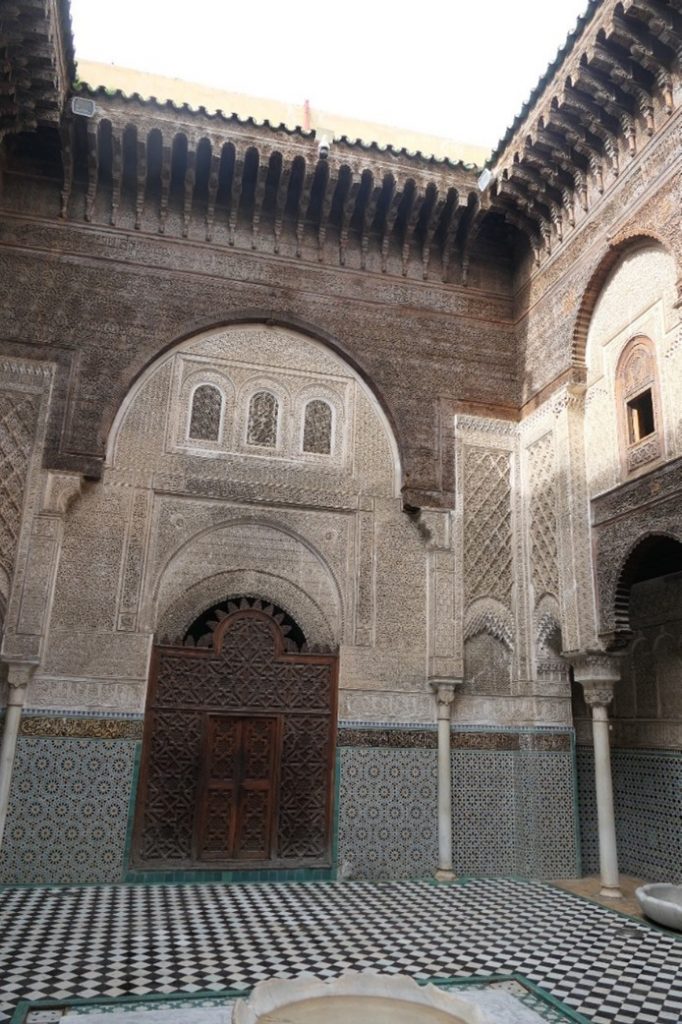
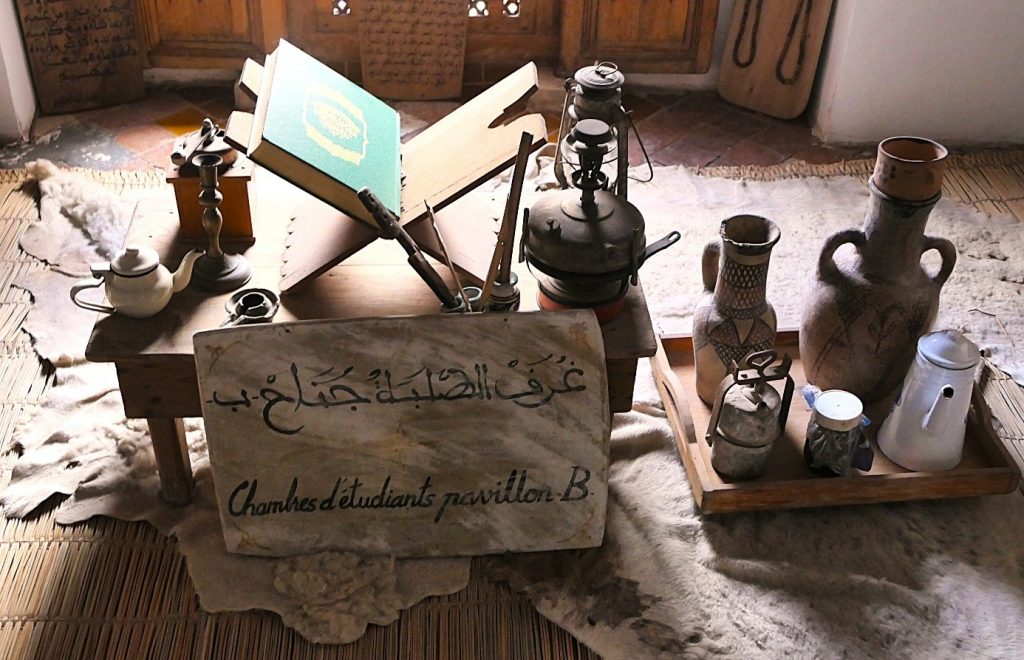
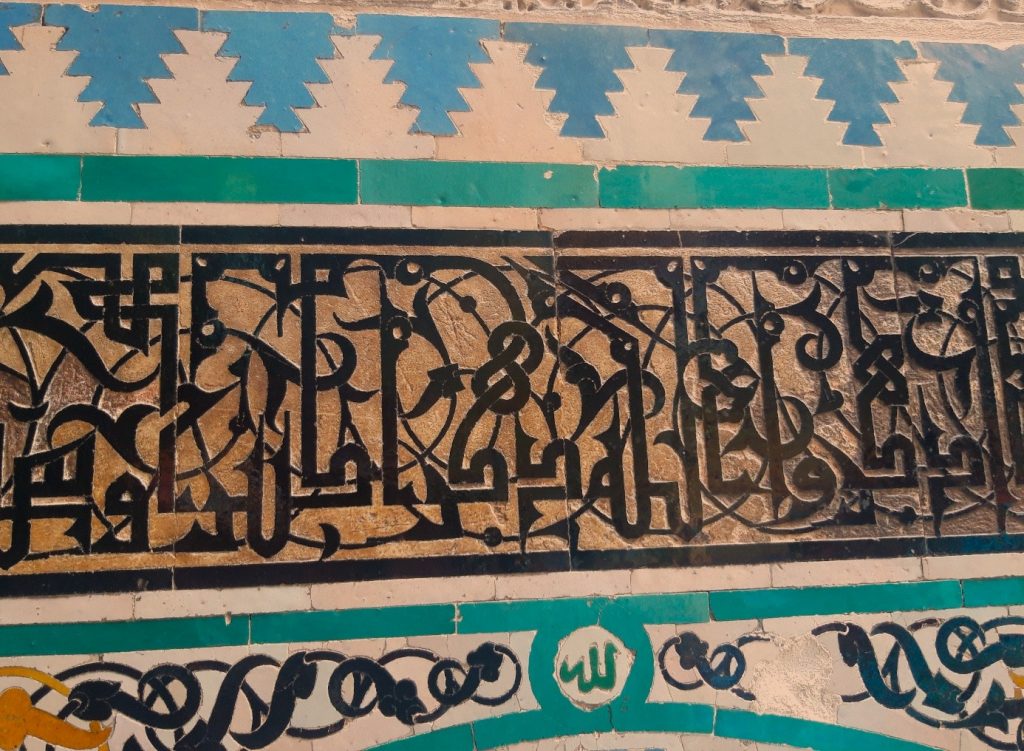
Surrounding the mosque are separate buildings housing the madrasas, the Islamic schools where students lived, studied and learnt, and also attended their own classes. Away from the hustle and bustle of the medina, this created a space entirely dedicated to learning, faith and art. Characteristic of the clear order of the Koranic schools are the rectangular courtyard, the gentle splashing of the fountain and the symmetrical architecture. Particularly impressive are the intricate ornamental decorations on doors and ceilings made of carved cedar wood, the delicate stucco featuring Koranic verses and the coloured mosaics on the walls and floor. These are still produced today using the zellij technique: handmade terracotta tiles are glazed, cut into geometric shapes and assembled like a jigsaw puzzle. The ornamentation is intended to demonstrate how knowledge and beauty are intertwined in Islamic thought. The small student cells, grouped around the courtyard, convey the simple, disciplined life of daily study.
Notable thinkers of the Middle Ages
The names of prominent scholars are associated with the University of Fez, such as the Jewish philosopher and physician Maimonides (1135/1138–1204), who influenced many later philosophers. Ibn Khaldun (1332–1406) is regarded as a pre-modern author whose work extends directly into the modern social sciences and history: his analyses of power, the economy, education, religion and social change – which, from today’s perspective, are interdisciplinary – address questions that were only systematically posed centuries later. It is not certain whether Gerbert of Aurillac, the future Pope Sylvester II, also studied in Fez: he later introduced Arabic numerals to Europe (see also tun24081101).
The University of Fez today: students and tourists
Following an eventful history, the University of Fez was reorganised in 1975. The old name ‘al-Qarawyyin’ was retained for theological studies; all other subjects are taught on a modern campus outside the old town at the University of ‘Sidi Mohamed Ben Abdellah’, and have been open to women since 1940. The mosque complex in the medina, squeezed between narrow alleys with a total of 14 entrances, is still a meeting place for scholars and a centre for theological studies.
The Al-Qarawiyyin Library is of particular importance to Islamic cultural heritage. It is considered one of the oldest surviving libraries in the world. The current library building, constructed in 1349, houses thousands of valuable manuscripts and over 30,000 books. A 9th-century copy of the Qur’an is among the oldest surviving copies of the Qur’an in North Africa. ‘Al-Muqaddima’, the magnum opus of Ibn Khaldun, is preserved in an ancient manuscript in the library. In it, Ibn Khaldun analyses the rise and fall of civilisations and their social dynamics and power structures.
In accordance with Moroccan custom, non-Muslims are not permitted to enter the old university building, as the mosque is still a place of worship. However, the madrasas surrounding the mosque are open to visitors, such as the Madrasa Al-Attarine, whose building is considered the finest example of a Koranic school in Morocco.
Is it really the oldest university?
Whether the educational institution attached to the mosque in Fez is in fact the oldest university in the world is occasionally called into question. Some historians of education regard ‘the university’ as a genuinely European invention, ‘a product of the Christian West of the 12th century’. Similarities with Muslim Koranic schools and their development are certainly recognised, but structural differences are emphasised, such as the existence of faculties. It is indisputable that academic life in Europe would have been inconceivable without the transfer of knowledge from the Islamic world via Andalusia and Sicily. The Islamic centres of learning in Fez and Cairo, and in Cordoba – then the largest city in Europe – were far ahead of the monastic centres of learning in Europe. Their contribution was decisive for the development of academic disciplines at the first European universities (see tun23050205) .
Finally, it should be noted that educational institutions existed even in early advanced civilisations where scientific thinking was taught in the modern sense of ‘higher education’, for example as early as 5,000 years ago in the Sumerian schools for training scribes in Mesopotamia. One might also think of the Buddhist institutions of learning in Nalanda, India, which existed from the 5th to the 12th century AD, where all the knowledge available at the time was taught. It is the case that these and similar institutions, for example in Pharaonic Egypt or ancient Greece, also disappeared with the decline of their respective cultures. Consequently, the ‘Solomonic’ formula of the longest continuous existence, as used by UNESCO or the Guinness Book of Records to designate the oldest educational institution, applies only to the University of Fez.
Further information:
University of al-Qarawiyyin – Wikipedia This article provides a comprehensive overview of the University of Fez.
Text and video from Deutsche Welle on the founding story of the University of Fez: Fatima al-Fihri: Founder of the world’s oldest university
Report by Deutschlandfunk on the university library:
Al Qarawiyin: The world’s oldest university is in Morocco
tun26042108