

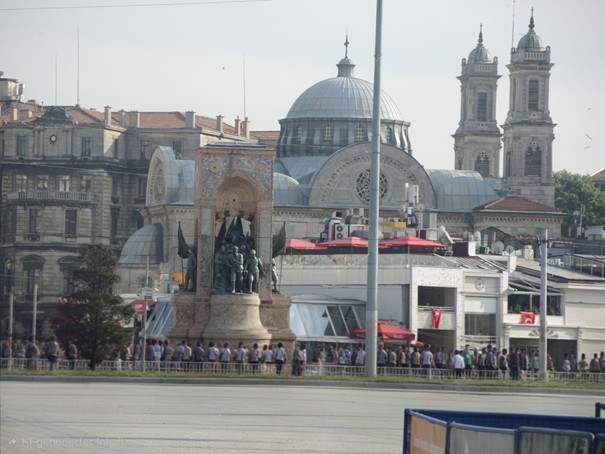
From Tahrir Square in Cairo to Taksim Meydanı in Istanbul and Maidan Nesaleschnosti in Kyiv to the al-Midan neighborhood in Damascus: A single word appears in the names of many places and in the news, even though thousands of kilometers separate them and the people there speak different languages.
How did the word spread? Where does it originate? And how did the term for an open square also become a symbol of science, work, and political protest?
From ancient linguistic roots to the “Midan” of the world
The oldest roots of the word “Maidan” are traced back to Proto-Indo-European. This is a reconstructed language from which many of today’s languages in Europe and parts of Asia are believed to have developed. Linguists reconstruct the form *médʰyos* for this language. It roughly means “middle” or “located in the middle.” In linguistics, the asterisk indicates that the word is not attested but reconstructed—and, since it predates the invention of writing, cannot be attested.
Words from various languages are compared to this root. These include the Latin word medius for “middle,” the Sanskrit word madhya- with a similar meaning, and the English word middle. In Proto-Indo-European, the Proto-Indo-Iranian form *mádʰyas is thought to have developed from this through further linguistic stages. For the early Iranian language stage, the form * mádyah is also reconstructed. From this, the reconstructed form * mádyanah, meaning “middle,” is thought to have developed. These ancient linguistic forms were reconstructed by linguists using the “comparative method”: one compares related words from different languages and derives a common original form.
Traces of this word family can be found in several Old and Middle Iranian languages. In Middle Persian, for example, there was the form mayān, meaning “center” or “between.” The modern Persian word meydān is related to this.
Through Arabic, the word spread to other languages, including Ottoman Turkish. In this way, it reached various regions of Asia and Europe. Its meaning continued to evolve: from a word for an open space, it also came to denote a battlefield, a venue for competition, or domains such as science, work, and politics. However, the original meaning of “center” was retained and evolved phonetically in different ways depending on the language.
Is “Maidan” originally an Arabic word?
Traditional Arabic dictionaries associate ميدان (maydān) with the Arabic root (M–Y–D), which denotes movement or swaying. This includes the verb (māda yamīdu), which describes something moving or swaying. Word forms such as (maydanan) are also mentioned in this context.
Some Arabic linguists explained the word based on this root and established a connection to an open space where horses could move about or people could gather for competitions and other activities. Others regarded (maydān) as a word of foreign origin that was borrowed into Arabic. Such words are referred to as Arabized: they adapt to Arabic pronunciation and grammar and, over time, become a natural part of the vocabulary. The traditional explanation alone therefore does not prove that the word is originally Arabic. In historical etymology, a foreign origin is often assumed.
In Arabic, (maydān) refers to an open space or area, but can also denote a battlefield, a competition venue, or a sports field. Furthermore, the word is used figuratively, for example in maydān aṭ-ṭibb (field of medicine), maydān al-baḥth (field of research), and maydān al-ʿamal (field of work). Politics and social conflicts can also be referred to as maydān.
The Persian Distinction: A Word on a Journey
In modern Persian, the word is written as ميدان (meydān). Among other things, it refers to a square, an open space, or a field.
The relationship between the Persian and Arabic words is complex from a historical linguistic perspective. While the Arabic maydān is often traced back to an older Iranian linguistic form, the modern Persian meydān is frequently regarded in etymological accounts as a loanword from Arabic. Here, one must distinguish between the oldest origin of a word and the language from which it was directly borrowed. It is likely that these developments intersected independently of one another.
How did “Midan” spread throughout Asia and Europe?
Related forms can be found in several languages: Turkish, Ukrainian, Polish, Urdu, Hindi, Uzbek, Kurdish, Azerbaijani, Pashto, Bengali, Greek, Serbian, Croatian, Bulgarian, and Romanian.
This spread is linked to historical contacts between language communities: trade, migration, political rule, and cultural exchange all contributed to words crossing borders. Depending on the language, the word may have entered other languages directly from Arabic or via intermediary languages such as Persian or Ottoman Turkish, and may then have spread throughout an entire language family, such as the Slavic languages.
When the “Maidan” Becomes a Political Symbol
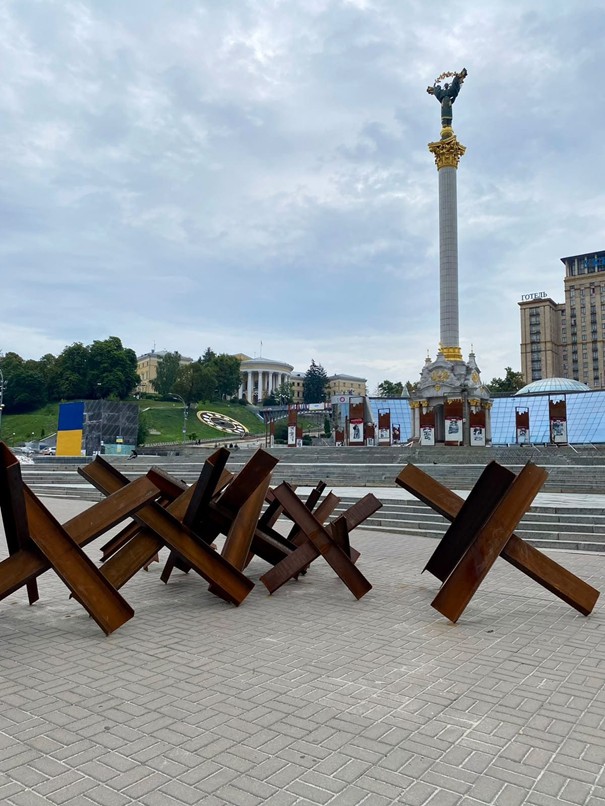
This symbolic significance is particularly evident in Ukraine. The Maidan Nezalezhnosti (Майдан Незалежності), Independence Square in Kyiv, became a key site of political protests.
During the Orange Revolution in 2004, large numbers of people demonstrated there against the controversial results of the presidential election. In late 2013, major protests began anew after President Viktor Yanukovych suspended the planned signing of an Association Agreement with the European Union. The movement expanded to include demands for political reforms and an end to corruption. In February 2014, Yanukovych lost his office following the escalation of the protests and the collapse of his political power.
Since the Orange Revolution of 2004—and especially since the protests of 2013–14—“Maidan” has also come to symbolize political protest, social mobilization, and political change on the international stage. In Ukrainian, however, the word continues to refer quite generally to a square.
Thus, the word “Midan” tells a story that goes far beyond the designation of a place. It connects languages and cultures, shifts in meaning, and is reinterpreted in different historical contexts—as a geographical location, a sphere of activity, and a symbol of social change.
Further information:
https://en.wiktionary.org/wiki/%D0%BC%D0%B0%D0%B9%D0%B4%D0%B0%D0%BD
https://en.wiktionary.org/wiki/%D9%85%DB%8C%D8%AF%D8%A7%D9%86
https://en.wiktionary.org/wiki/%D9%85%D9%8A%D8%AF%D8%A7%D9%86
https://alankaa.com/etymology/%D9%85%D9%8A%D8%AF%D8%A7%D9%86
https://en.wikipedia.org/wiki/Maidan?utm
tun26101401