

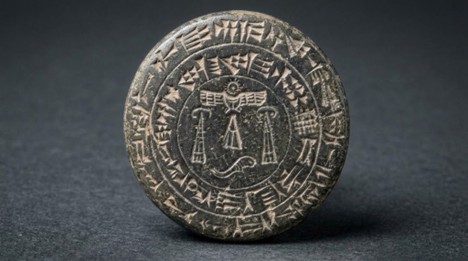
Seals are commonplace today, as nations, their government bodies, and institutions have their own seals that express their identity and culture. Yet it is largely unknown that the history of seals dates back thousands of years and that they originated early on in Mesopotamia, the land between the rivers. From there, their use spread and continued to evolve. To this day, seals remain an important means of documentation and proof of identity.
Political and economic relationships among people—whether between individuals, groups, or settlements—have existed for a very long time. Initially, there were no clear-cut means of documenting transactions, agreements, and contracts. With the development of administrative and social structures, the practice of “sealing” emerged, from which the system of seals known today later evolved.
In the early stages of sealing, clay played an important role. The seals themselves were made from various materials and served to leave an impression or mark on soft clay. This allowed property, goods, transactions, or documents to be marked and authenticated. Over time, seals evolved in terms of their shape, content, function, and the materials used. They became an important tool in administration, economics, and politics. In addition, they sometimes bore symbols and images that reflected the status or authority of the seal’s owner.
From Jewelry to the First Seals
As early as the 7th millennium B.C., objects resembling later seals have been found in northern Syria and Mesopotamia. These objects were mostly made of stone, had a round or nearly round shape, and were decorated with geometric, plant, or animal motifs. Some of them had a hole through which they could be attached to a cord or hung. They may have served as personal jewelry or as amulets to ward off evil spirits.
As societies evolved, these forms were increasingly used for practical and administrative purposes, particularly for sealing, storing, and protecting property. The finds from Tell Sabi Abyad in northern Syria are among the most important evidence of this development. Archaeological excavations have uncovered stone seals and a large number of seal impressions on clay, particularly from the late Neolithic period, approximately 6200 to 6000 BCE.
Sealing was performed by applying a lump of moist clay to the closure of a vessel or basket and then imprinting it with a seal. A variety of motifs can be seen on the impressions, including geometric shapes as well as animal and human figures.
These impressions served to protect the contents of the containers and control access to them. This is because opening the closure damaged or altered the seal impression, making any prior tampering or opening detectable. This practice demonstrates that the seal was no longer merely decorative but had become an important tool for ownership, storage, the control of resources, and the organization of exchange transactions.
Studies have also shown that the clay used for some seal impressions at Tell Sabi Abyad came from the surrounding area. This suggests that the sealing was carried out directly on site. Tell Sabi Abyad thus represents an important stage in the history of the development of seals and sealing in Syria, predating the emergence of writing and complex administrative systems in Mesopotamia.
Innovations: Cylinder Seals and Early Writing
In the fourth millennium B.C., a significant development occurred in the history of the manufacture and use of seals and sealing, particularly in Mesopotamia. The growth of settlements and the development of economic and administrative activities led to an increasing need for means of control.
During this phase, the cylinder seal (also known as a roll seal) emerged and became widespread. It consisted of a small piece, usually made of stone, with scenes or symbols engraved on its surface. It was then rolled over damp clay to leave a continuous impression. This type of seal allowed for the depiction of more complex and varied motifs than flat seals.
The seals now featured more complex depictions, including animals, human figures, rituals, and scenes of labor and production, as well as symbols and mythological figures. Sealing became an important part of the administrative and economic system, as it served to seal containers, control goods, and establish ownership.
The development of seals during this period was also linked to the emergence of the earliest forms of writing in Mesopotamia. Therefore, the seals and their impressions represent an important source for the historical understanding of the origins of administration, economy, and writing in the early societies of the Ancient Near East.
3rd Millennium: Seals as a Specialized Art Form
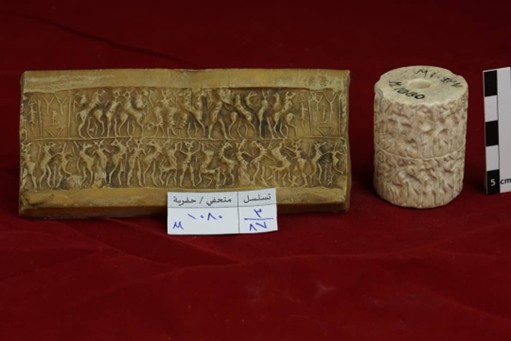
In the third millennium B.C., the cylinder seal evolved into one of the most important tools for sealing. Its role was no longer limited to the protection of property and containers but was now also linked to administrative, economic, and legal systems. Technically, seals also continued to evolve, now featuring more complex and diverse depictions, such as gods, kings, animals, mythical creatures, and scenes of war, hunting, and religious rituals. In addition, cuneiform inscriptions appeared on many seals, containing the names and offices of individuals and sometimes also the names of gods or kings.
Thus, the seal combined image and writing, fulfilling both an administrative and a personal function. It served to identify the seal’s owner and to establish that person’s responsibility for property or transactions. The seal also became a symbol of its owner’s social and administrative status. Seal-making developed into a specialized art form characterized by the precision of its engraving and the diversity of its motifs.
Royal Seals as the Culmination of This Development
Royal seals underwent significant development during the Bronze and Iron Ages, gradually transforming from a means of authentication and sealing into a symbol of identity, power, and royal legitimacy.
In northern Syria, the seals of the kings of Yamhad and Alalakh—such as the seal of Idrimi—represent important examples of the connection between the seal and the king, religion, and power. In the Late Bronze Age, Hittite royal seals also appeared, bearing the names of the kings and symbols of royal power.
During the Iron Age, particularly in the Neo-Assyrian Empire, the seal became an essential component of royal administration. Seals and impressions from the reigns of Ashurnasirpal II, Sennacherib, and Ashurbanipal have survived, bearing religious and mythological depictions as well as inscriptions with the kings’ names and titles.
In some cases, officials carried the royal seal with them and used it on behalf of the king. As a result, the seal became a means of transferring royal authority and of proving that an order or document had been issued in the king’s name. Thus, by the end of the first millennium B.C., the seal had become an instrument that combined authentication, identity, power, and political legitimacy.
The Seal in the Modern Era
Although thousands of years have passed since then, some of the seal’s fundamental functions have persisted into the modern era. Nevertheless, its use and significance have changed considerably.
In modern times, the seal is primarily used in certain institutions, government agencies, and companies to confirm the official nature of documents and to identify the issuing authority. The use of seals has become part of bureaucratic procedures and has been mass-produced through printing. Nevertheless, the seal is no longer the sole means of authentication. Signatures, electronic documents, and digital signatures have become important tools in modern business transactions.
Thus, it can be said that the primary function of the seal has gradually shifted from the protection of property and the control of goods to the authentication of documents and the verification of their official validity. However, some of its earlier functions persist to this day.
Further information:
Rolling Seals: The Finest Script on Stone
Mesopotamian Cylinder & Stamp Seals – YouTube
https://www.geschkult.fu-berlin.de/e/vaa/forschung/projekte_laufend/KISIB/index.html
https://www.youtube.com/watch?v=8WJRYkd4e2U
tun26092207