

How do you interact with people who are visually impaired? Do you offer to help? And how? What may sometimes seem complicated is actually quite simple: It’s not about special rules or “special treatment,” but about basic respect and attentiveness to the needs of others.
Respect Starts in Everyday Conversation
Accessibility experts emphasize that people with visual impairments lead active lives: they work, study, travel, raise children, and are present in all areas of society. It is therefore crucial not to create additional barriers for them due to a lack of knowledge. When meeting or speaking with someone, it is helpful to identify yourself and any other people present. This makes it much easier for them to orient themselves in the situation. It is equally important to address the person directly and not to communicate through their companions.
Describing directions also plays an important role. Instead of vague terms like “there” or “here,” specific landmarks should be used, such as “to your left,” “two steps straight ahead,” or “on the table to the right.” Such descriptions improve clarity and prevent misunderstandings.
Everyday Details with Great Significance
In everyday life, it is often the little things that have a big impact. For example, when a cup of coffee is brought over or a document is placed on a table, a brief explanation of where the item is located should be provided. It is equally important not to move objects without prior consultation. What may seem insignificant to sighted people can completely alter spatial orientation for people with visual impairments. When something changes in the environment—such as when people enter a room, the situation changes, or a potential hazard arises—a brief description of the situation ensures safety and orientation.
Tactile guidance systems are not just a design feature, but a safe way to navigate
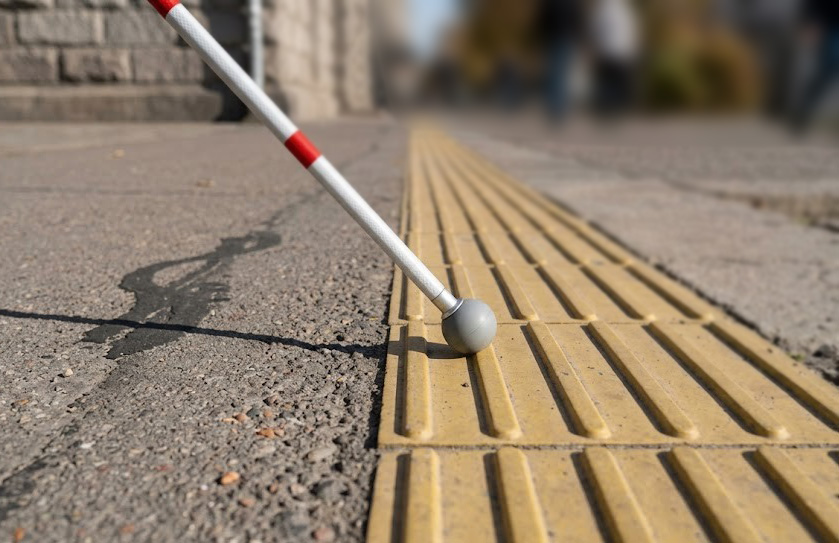
Like textured pavement markings, specialized tactile guidance systems help people with visual impairments find their way in public spaces. They are particularly important for people who use a white cane. In everyday life, parked bicycles, e-scooters, or even cars frequently block these guidance systems. What may seem like a minor obstacle to passersby without visual impairments can hinder a safe path for blind or visually impaired people. Such obstructions usually occur unintentionally, stemming from ignorance or a lack of attention. This makes it all the more important not to look away. If obstructed guidance systems are noticed, even a simple reminder or a brief explanation can help ensure greater consideration in the future. Such small actions gradually contribute to creating a city where safety does not depend on chance.
Help Without Being Intrusive
When offering help, the general rule is: never act without being asked. You should not simply take a person’s hand or lead them. It is more appropriate to first ask the person if they would like assistance. If they agree, discuss the type of help needed.
Experts also highlight the special role of guide dogs. These animals are not pets, but specially trained assistance dogs that can be crucial to the safety of their owners. Therefore, they should not be petted, distracted, or spoken to without permission.
tun26051905