

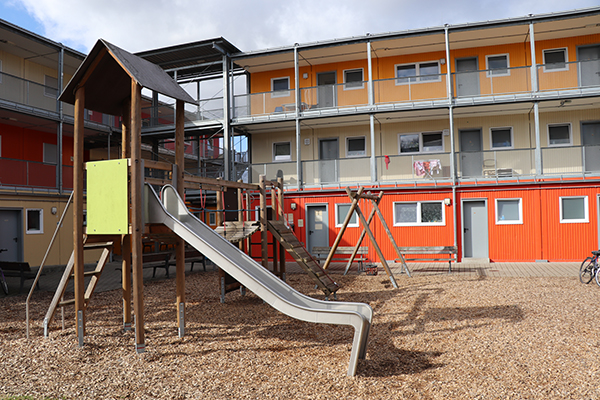
The number of refugees arriving in the Tübingen district is declining. As a result, the District Office can transfer one-third of the apartments it had previously rented and set aside for the “temporary housing” of up to 1,117 people (as of early 2025) to cities and municipalities. This gives them more capacity for the “follow-up housing” of refugees, whom they are responsible for supporting. The District Office confirmed this in response to an inquiry from tuenews INTERNATIONAL. Refugees in follow-up housing not only have different “landlords” and building managers, but they also receive a lease and must register with the local municipal office. Refugees who are working must also pay rent themselves for their apartment in the follow-up housing. The Jobcenter or the Social Welfare Office only covers the costs as long as someone has no income of their own.
The transfer of apartments from the district to the municipalities is expected to be largely completed by summer. Refugees who have remained in district accommodations as “misplaced occupants” because the municipalities had no apartments for them can, ideally, stay in their current rooms: “If apartments can be transferred to the cities and municipalities together with the refugees, the refugees can remain in the apartments and do not have to move despite the transition to follow-up housing,” the district administration office states.
Complicated rules
Who is responsible for the housing of which refugees, when, and how, is precisely regulated by law: In Baden-Württemberg, refugees are generally first placed in a State Initial Reception Center (LEA), for example in Karlsruhe. State authorities then assign them to a district from there. The District Office remains responsible until the asylum procedure is completed, but for no longer than two years. After that, those granted asylum or asylum seekers are transferred to the jurisdiction of cities and municipalities and thus into their follow-up housing.
Shift Primarily in the Cities
While the district’s reduction of housing is intended to take place across the entire district, the focus is on the cities of Tübingen, Mössingen, and Rottenburg. There, the district office is primarily transferring smaller apartments to the municipalities. These are more popular with refugees than group housing facilities. As part of the reduction of its capacity for the initial reception of refugees, the district is also completely closing down accommodations that are in poor structural condition. There is no plan to force municipalities to take them: “The cities and municipalities decide for themselves whether they have a need for accommodations and whether they want to take over our facilities,” the district administration states.
tun26052905