

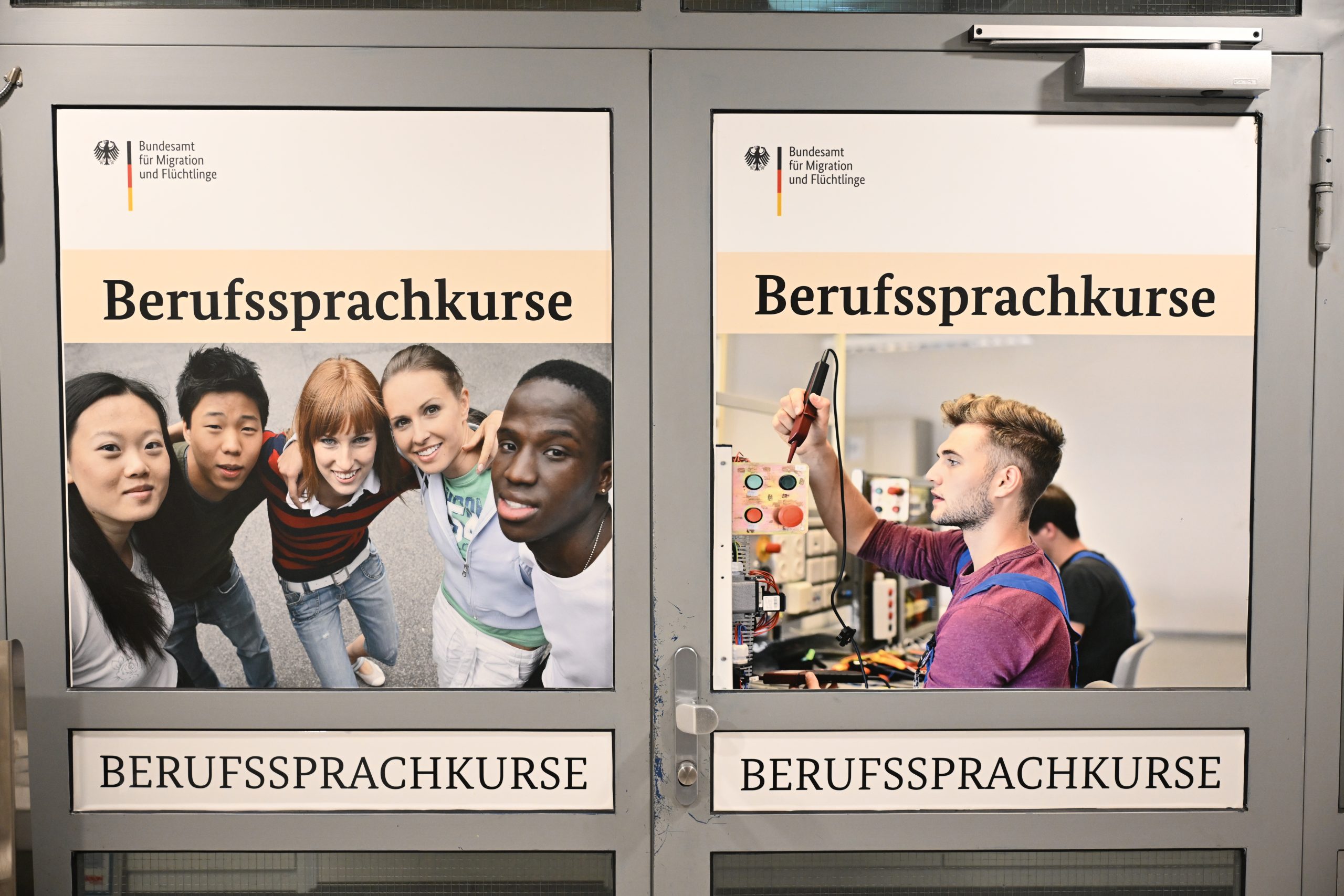
The Federal Office for Migration and Refugees (BAMF) is expanding its offerings of vocational language courses that took effect on October 1, 2026, according to the agency. In particular, significantly more courses will again be available at the B2, C1, and C2 language levels. Certain types of courses that had recently been suspended or severely restricted will also be able to resume. According to the BAMF, these regulations will remain in effect through the first half of 2027. The vocational language courses build on the integration courses and provide people with refugee and migrant backgrounds with targeted language skills for the workplace. According to the BAMF, the vocational language courses are offered for all professions—from apprentices to dentists.
More Courses at Levels B2, C1, and C2
In the future, demand for B2 courses is expected to be fully met. The offerings at the C1 and C2 levels will also be significantly expanded and will be tailored to actual demand. This will particularly benefit immigrants who need advanced German language skills for skilled employment, continuing education, or the recognition of a foreign professional qualification.
B1 and Vocational Practice Courses Resume
Starting in October, vocational language courses aimed at the B1 level will once again be offered. However, the number of available spots remains very limited. Priority will be given to individuals who are likely to find employment after successfully completing the course. Courses at the A2 level are still not available.
Vocational language courses with a focus on practical skills are also returning. These are primarily aimed at participants with little prior learning experience and combine language acquisition with practical tasks in a simulated workplace setting. The goal is to teach the German language skills required for entry-level assistant positions.
Workplace-oriented courses continue
Job-specific language courses, courses for apprentices, programs for employees in early childhood education, and language courses offered as part of a professional certification process may continue to take place. These courses are geared toward specific job duties and typical communication situations in the workplace.
Which programs actually begin locally depends on regional quotas, demand, and the availability of educational providers.
How to Enroll in the Course
Eligibility is required to participate. Job seekers and individuals receiving benefits from the Jobcenter or the Employment Agency should contact their designated representative.
Employed individuals who are not registered as job seekers with either the Jobcenter or the Employment Agency can apply for eligibility directly with the BAMF. Individuals undergoing a professional qualification recognition process can also submit a corresponding application there. Registration with an accredited training provider follows.
Since availability varies by region, it is advisable to start looking for a suitable program early.
Courses Are Often Free
Vocational language courses are free for job seekers, apprentices, and recipients of social benefits. For employed individuals, exemption from the cost contribution has been based on gross income and the number of eligible children since April 30, 2026.
In 2026, participation will generally be free for employed individuals if their annual gross income is less than 33,462 euros. With one child, the threshold increases to 43,602 euros; with two or more children, it rises to 53,742 euros. Those whose income exceeds the applicable threshold currently pay 2.56 euros per class session. The income thresholds are adjusted annually.
Further Informations:
BAMF: Öffnung der Berufssprachkursangebote ab dem 1. Oktober 2026
BAMF: Änderungen der Deutschsprachförderverordnung zum 30. April 2026
BAMF: Informationen zu Berufssprachkursen und zur Teilnahme
BMAS: Sozialversicherungsrechengrößen 2026
tun26072202