

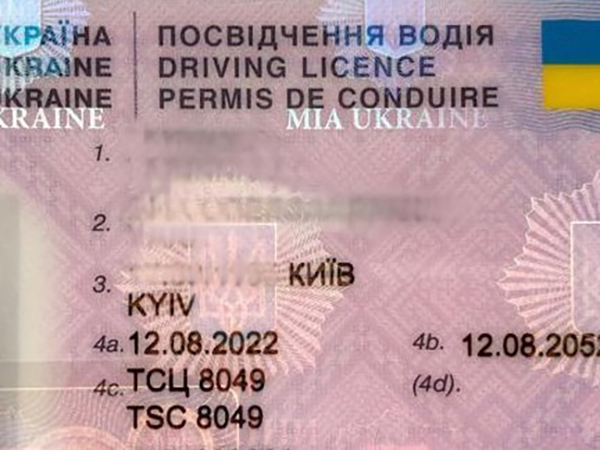
Since 18 August 2026, Ukrainian driving licences can be converted into German licences much more easily. Ukraine – along with Montenegro – has been added to Annex 11 of the German Driving Licence Ordinance (FeV). As a result, holders of the listed licence categories no longer have to take either the theoretical or practical driving test.
Which categories does this apply to?
The new rules apply to valid Ukrainian driving licences in categories A1, A, B, BE, C1, C1E, C, CE, D1, D1E, D and DE. Anyone who holds a corresponding Ukrainian licence and wants to convert it into a German one does not have to take either the theoretical or practical test in Germany.
For category B, an eyesight test, a first-aid course and training at a driving school are also not required for the conversion. Additional requirements may continue to apply to lorry and bus categories. Depending on the licence category and its period of validity, these may include medical examinations and proof of adequate eyesight. The new rules do not apply to professional driver qualifications.
How does the conversion process work?
The application for conversion must be submitted to the responsible driving licence authority at the applicant’s place of residence, known as the Fahrerlaubnisbehörde or Führerscheinstelle. Depending on the city or district, this office may be part of the district administration, municipal administration or citizens’ service office.
The required documents and procedure may vary depending on the driving licence category and the responsible authority. As a rule, applicants need a valid Ukrainian driving licence, an identity card or passport and a recent biometric photograph. In some cases, the authority may request additional documents. Applicants should therefore check the exact requirements with the responsible driving licence authority in advance.
A translation of the Ukrainian driving licence is not required in every case. For example, it may not be necessary if the authority’s staff can read the information on the licence without a translation – particularly if it is also provided in English or in the Latin alphabet. There is no uniform rule throughout Germany. Before paying for a translation, applicants should therefore ask the responsible driving licence authority whether one is actually required.
The fee for the conversion may vary depending on the city or district. Additional costs may arise, for example, for a translation, data verification or required medical documents.
What applies to refugees from Ukraine?
Ukrainian driving licences held by people with temporary protection continue to be recognised in Germany and the other European Union member states for the duration of this status. They do not need a certified translation or an international driving permit to drive a vehicle. This also applies to Ukrainian licences that expired after 31 December 2021. Anyone who remains permanently in Germany after temporary protection ends will be able to convert their licence without taking theoretical or practical tests.
Ukraine’s inclusion in Annex 11 of the FeV is based on the “First Ordinance Amending the Professional Driver Qualification Ordinance and Other Road Traffic Regulations” of 12 August 2026. It was published in the Federal Law Gazette (Bundesgesetzblatt) on 17 August 2026. The amendment adding Ukraine to Annex 11 entered into force on 18 August 2026.
Sources:
Bundesgesetzblatt – BGBl. 2026 I Nr. 236:
https://www.recht.bund.de/bgbl/1/2026/236/regelungstext.pdf
https://www.adac.de/verkehr/rund-um-den-fuehrerschein/auslaendische-fuehrerscheine/fuehrerscheinumschreibung-fluechtlinge
tun26081908