

The US and Israel launched their air strikes on Iran on February 28, 2026. They did not only target military and strategic sites. The Supreme Leader Ali Khamenei and other members of the regime were also killed. The same day, Iran retaliated by firing rockets and drones at Israel and US military bases in the Gulf states. How are Iranians coping with the war and what are their expectations? Iranians from the Southwest of Germany spoke to people in their home country about the situation. To protect them, their names have been anonymized in this article. Especially since a new law is currently being drafted in Iran that would ban and punish interviews with media outlets considered hostile.
The situation half a year after the start of the war can only be understood in the context of what happened before. In response to the protests in January 2026, the mullah regime had resorted to persecution, extreme violence, targeted killings even in hospitals, and the execution of opposition members (see first link below).
Families try to save on everything
All interviewees report a very tense atmosphere half a year after the start of the war. “People are afraid of the war, of the government, of economic problems, and of their own future”, says T. Especially because the outcome of the war and its consequences are completely uncertain. Sanctions and naval blockades combined with the political and military situation have led to massive inflation, R. reports. People are trying to save everywhere. Expensive rents and high prices are also hitting the middle class. “Families are eating less”, says S., they are forgoing meat, fruit, and new clothes, for example. Some, R. says, are trying to avoid doctor visits because of the cost. In some cases, he has heard that “medical treatments are now being paid in instalments”. Many young people who run businesses or offer services via Instagram have had their livelihoods cut off for a long time by the complete shutdown of the internet.
Regime-aligned individuals benefit
“Everything has gotten worse”, says S. Wealth and economic opportunities in the country are unevenly distributed. “In particular, the economic power of the Revolutionary Guards and the companies associated with them has created structures that benefit primarily regime-aligned individuals and networks”, says R. Added to that are nationwide unemployment, corruption, and uncertainty. In his home region in the northwest, he says he has not heard of any civilian casualties from bombings since February. Air strikes there have targeted military facilities and regime security centers.
People from the south flee from bombs
Meanwhile, people in the Tehran region have suffered numerous bombing attacks. Many people, S. says, fled the capital and the south. A relative of S. was so badly injured by the blast wave that he had to go to hospital. According to unverified reports from the Iranian Ministry of Health, almost 25.000 people were injured by the end of April. The United Nations reported more than 2.400 civilian deaths by 10 April. There are no more recent reliable figures.
The regime mobilizes its supporters
Opinions on the war are very divided, all interviewees say. This is also due to the fact that people have different access to information. When the internet was shut down, independent information could not get in or out of the country. In contrast, R. says, the state’s version of events was present around the clock on television, radio and in public spaces. There, you can see large numbers of supporters of the regime. “They were brought out onto the streets over months of state-organized manifestations”, R. says, “to show their loyalty to the leadership.”
Hope for a strong external actor
Other segments of the population supported the war because, according to R., they “no longer see any possibility of change on their own”. Some hoped that a strong external actor, such as the US or Israel, could remove the regime or at least weaken it decisively. On social media, there was a reference to the fact that Germany and Japan had been rebuilt after being almost completely destroyed in World War II, R. found out.
Retreat into privacy due to uncertainty
A third group, which R. calls the “gray zone,” is primarily concerned with its own survival. The regime is exploiting the uncertainty about what might happen after the war. “With nationalist rhetoric and the narrative of `Iran against the external enemy,’ it is trying to bind people in this gray zone more closely to itself”, R. says.
The mullahs are more powerful than before the war
According to political observers around the world, the power of the mullah regime, and especially the Revolutionary Guard, has increased significantly since the protests at the beginning of January. There is no longer any talk of freedom for the Iranian people internationally. US President Donald Trump has not achieved any of his war aims, writes the German news magazine “Der Spiegel” in a commentary: “The Islamists are still in power, they still have the ability to build nuclear weapons, and they now know how much damage they can inflict on the world economy by closing the Strait of Hormuz.” On March 2, the regime announced for the first time that the 35-kilometer-long waterway between Iran and the Gulf of Oman would be closed. The world economy is not only suffering from the huge rise in oil prices. Iran and Oman are planning to charge a toll for passage through the strait.
Repression prevents mass protests
Our interviewees also assess the situation much more negatively than in previous years. They cite the regime’s massive repression – including death sentences for opposition members – as one reason. “Anyone who talks about freedom or protest today can be accused very quickly of spying for the US and Israel”, R. says by way of example. When “the knife goes to the bone,” as a Persian saying goes, when the (economic) situation becomes even more unbearable, people may go back to the streets despite the danger – that is a cautious assessment from Iran.
No more hope in Trump and Pahlavi
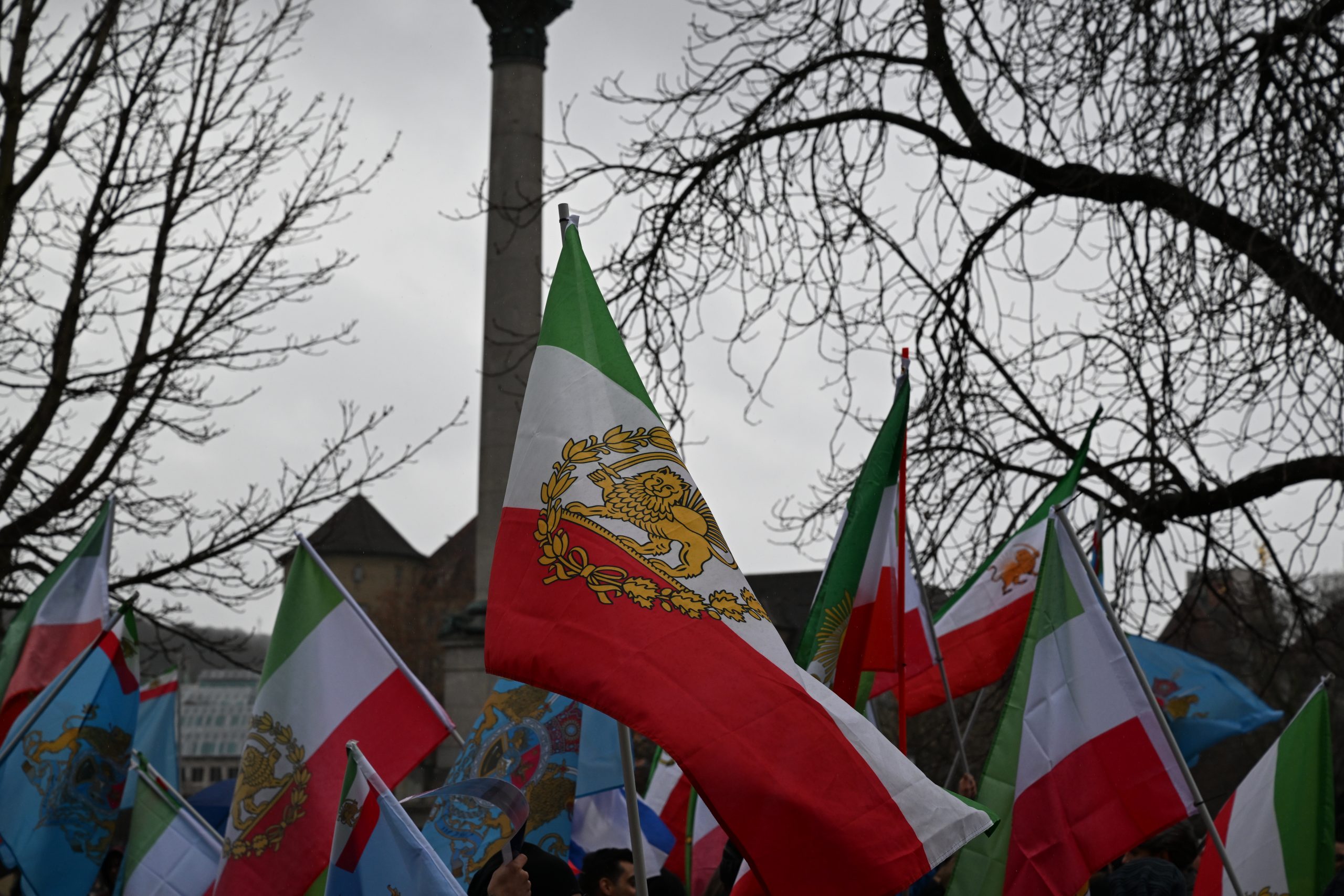
“Many who were in favor of Trump’s war”, says S., “now deeply regret it and are against it.” Some circles of the population, according to R., have seen the son of the exiled Shah, Reza Pahlavi, who lives in the US, as a beacon of hope. R. explains this with a certain degree of nostalgia. But there is no news of Pahlavi at the moment. R. sees a problem: “He and his entourage within Iran do not have the structures and means to effectively challenge such a violent security apparatus.” Other potential hope-bringers are not known.
The dream of security and democracy lives on
One reason for the seemingly hopeless situation is the regime’s tactics. Over decades, it has weakened and divided the opposition. “To this day”, ,R. concludes from his conversations with Iranians, “it has therefore failed to form a united and effective front.” The future cannot be predicted. But R. and the other interviewees are certain of one thing: The people want to live in economic security, in peace with other societies, and to have political and personal freedoms in a democratic system. Despite all the difficulties and their powerlessness in the face of the regime, T. says, people go to work, take care of their families, and try to live a normal life – even, according to S., “to keep their good mood up”. She calls this “the Iranian spirit.” Currently, peace and freedom are not within reach for Iranians. “At the moment, people are on the brink of a conflict,” says R., “the course of which they can hardly influence themselves.”
People expect more support from the outside
From the outside, most Iranians feel little noticed and even less supported. Europe, for example, exerts far too little pressure on the Iranian government when it comes to human rights violations. This is a widely held opinion in the country. Although the European Union and 26 other countries jointly condemned the execution of protesters on August 12, a statement alone is not enough to end the power of the mullahs, according to the criticism from Iran that T. has summarized.
For background information, see:
https://tuenews.de/iran-das-regime-bringt-seine-bevoelkerung-um/
Sources:
R. S. and T.’s research in Iran
International media
Comprehensive dossier on Iran by the German Federal Agency for Political Education:
https://www.bpb.de/themen/naher-mittlerer-osten/iran
tun26080505