

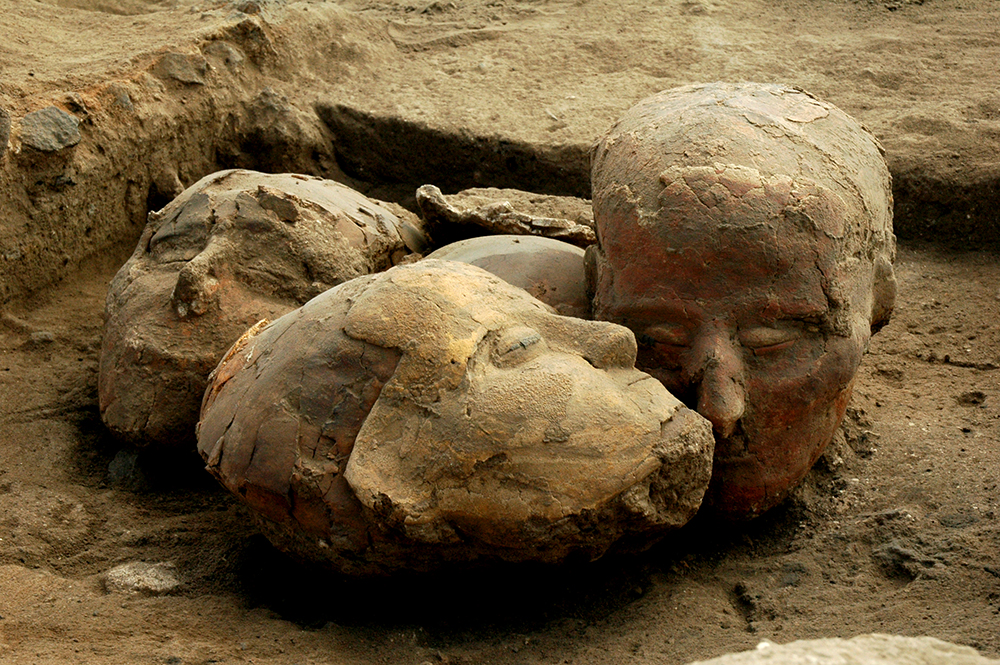
Traces of religious beliefs can already be found in the oldest archaeological finds from prehistoric times, particularly in those relating to ideas about the afterlife in the burial of the dead. Ancestor worship, which existed in several regions of Syria as well as in other parts of the Middle East and Turkey, is one of the most striking elements of these beliefs.
Skulls in homes: ancestor worship as early as 11,000 years ago
Tell al-Qaramel, a settlement that existed between around 12,000 and 8,000 BC, is located north of Aleppo in Syria. Here, the first signs of villages appear, evidencing a gradual transition from simple huts to permanent houses over a prolonged period. This permanent settlement and increasing stability led to the domestication of animals and the cultivation of plants. At the same time, the arts developed considerably, particularly the decoration of river pebbles, which were used as tools in daily life. These artistic decorations depicted plants, animals and the religious beliefs of the time, particularly in the 9th millennium BC.
The houses are among the richest archaeological sources at this site, as they show a continuous development from circular to rectangular floor plans. However, the introduction of new forms did not mean that the older ones were abandoned; thus, semi-rectangular houses frequently appear alongside round and oval ones.
Religious beliefs appear to have held particular significance at this site in connection with ancestor worship. Four human skulls, without associated skeletons, were found in various places on the floor of a house. The floor of the house had been prepared in such a way that the skulls remained visible to the inhabitants and visitors.
However, the skulls were not found in all houses, but only in a single house. In other houses, as well as beneath and near the buildings, complete skeletons with skulls were found. This could suggest that the skulls were not removed from all the deceased, but only from certain individuals.
Further development: modelled skulls
Finds from southern Syria at Tell Aswad, near Damascus International Airport, demonstrate a significant further development of these ideas regarding the separation of head and body. Tell Aswad dates from the seventh millennium BC. Several large houses were excavated at this site, and numerous clay figurines depicting animals were discovered. Skulls were discovered there whose faces had been modelled in plaster and painted in red and other colours. They appear to represent attempts to recreate the faces of the deceased as they might have looked before their death. The skulls were found in groups of up to five; sometimes they surrounded a human skeleton.
Why were the skulls separated from the body and modelled?
Several hypotheses have been put forward regarding how the skull was separated from the body. All, however, point to a rite of passage aimed at transferring the skull from the grave into the house. To date, no direct physical evidence has been found that conclusively proves this process. It is, however, assumed that the aim was to assign the deceased a new role in the spiritual and symbolic life of the community only after the burial. At the same time, the connection to the place and the collective identity of the community was emphasised by the physical presence of the ancestors – or a part of them.
The most widely discussed hypothesis suggests that following the death of a person – who held a special status due to their age, religious role or position in society – the entire body was initially buried in the ground for a certain period of time. Once the body had decomposed, only the skull, usually without the lower jaw, was removed.
This was followed by the process of modelling or plastering, in which the face was covered with plaster to give it an artistic and aesthetic form. During this process, the eyes, mouth and nose were depicted. The skull was then taken to a special place in one of the houses, so that it remained visible to family members and possibly also to the community.
It appears that this process continued over several generations, which explains why multiple skulls were discovered together at some sites. Later, after the inhabitants had left the village, the skulls were buried in the house or beneath the floor, thereby preserving them archaeologically to this day.
However, there is also evidence of a different, possibly older practice, as observed at Tell al-Qaramil. In this practice, the head was severed from the deceased immediately after death using a sharp flint tool and subsequently kept in the house. It therefore appears that the later decoration of the skulls represents a further developed practice that evolved from an earlier tradition in which the skulls were initially used without any decoration or additions.
Why keep and display the skull?
Many ancient societies regarded the skull, like the head, as the centre of human power, identity and spirit. Preserving it therefore symbolically meant preserving the wisdom and power of the ancestors. The presence of the skull within the home could also represent a spiritual connection between the living and the dead. In this sense, it functioned as a kind of mediator or vessel for the spirit of the deceased.
Furthermore, the skull held strong symbolic significance in many ancient societies. Its permanent presence in the home enabled a long-term physical and symbolic connection between the ancestors and subsequent generations – children and grandchildren. It thus represented not only the physical but also the spiritual presence of the older generations.
This practice reflects the religious and social beliefs of that time. The associated burials provide material evidence of the attempt to maintain a continuous and active relationship between the world of the living and the world of the dead. At the same time, they point to a close connection to the community’s collective memory and to ancestor worship.
Ancestral rituals in Asia
Similar practices developed in various parts of Asia, but are often associated with the preservation of ancestral bones or skulls as part of family rituals. In some regions of Southeast Asia, such as Indonesia, groups like the Toraja people maintain burial traditions in which the remains of the deceased are exhumed after a certain period and reburied in specific locations within the family graves.
Furthermore, rituals are held regularly in which the dead are visited and offerings are made to them. This represents a clear expression of the ongoing relationship between the living and their ancestors.
In Japan, some burials from the Jōmon culture suggest practices such as the rearrangement or isolated placement of skulls within burial sites. This may reflect the symbolic role of the head as the centre of human identity. These practices in Asia are characterised by a greater focus on the continuity of the relationship between family and ancestors than on their connection to public sacrificial rituals or religious representations.
Skulls from human sacrifices among the Aztecs and Maya
In contrast, skulls held a different significance in the Aztec and Maya civilisations of Mexico and were frequently associated with public religious rituals and human sacrifices. So-called ‘tzompantli’ were created – wooden platforms on which the skulls of human sacrifices were displayed.
Prominent examples of such structures were found in large temple complexes such as the Templo Mayor in present-day Mexico City, where hundreds of skulls were discovered. These were associated with religious rituals aimed at appeasing the gods and ensuring the continuity of the cosmic order, particularly with regard to the solar cycle and agricultural fertility.
From prehistory to the present and future
The study of prehistoric ancestor cults in connection with the display of human skulls exemplifies the importance of archaeological research into prehistoric societies, particularly those of the last 12,000 years. Their archaeological heritage continues to influence the formation of cultural identity, intergenerational communication and the sense of belonging to a particular place to this day. For many modern societies strive to connect their roots and cultural identity with those of earlier civilisations – be it through scientific research, modern technologies such as digital models of archaeological sites, or historical narratives.
For this reason, societies worldwide are striving to preserve and protect their cultural heritage – not only for the present generation, but also for future generations.
tun26030303