

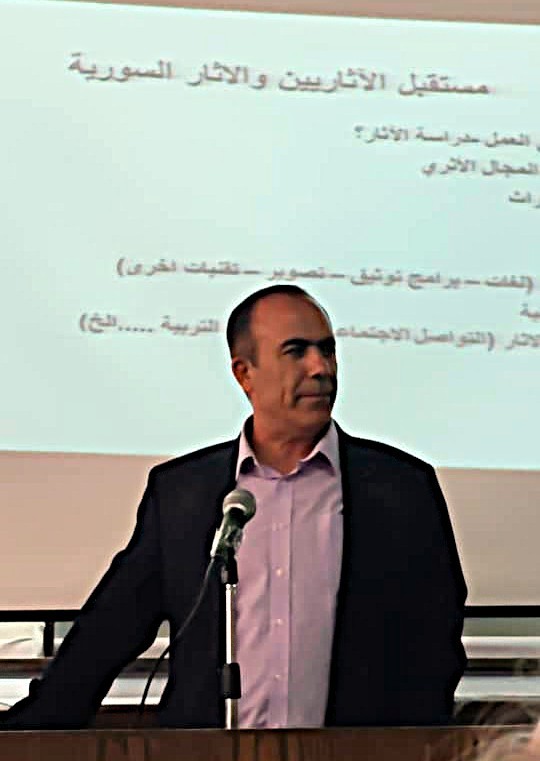
tuenews INTERNATIONAL contributor Youssef Kanjou, a Syrian archaeologist and former director of the National Archaeological Museum in Aleppo, travelled to Syria again in May 2026 to hold talks on planned archaeological projects. This visit turned out to be something very special for him, as students and lecturers from the Department of Archaeology at the University of Aleppo asked him to give a lecture on the 25 international excavation projects in the Aleppo region between 2000 and 2010. He had overseen these campaigns as excavation director in his capacity as museum director until the war in Syria brought all these activities to an end.
First lecture in 14 years
Neither the students nor the very young lecturers, mostly in their thirties, knew much about the results of these excavations, as all publications on the subject have since appeared mostly in English and certainly not in Arabic. Fourteen years have passed since Youssef Kanjou’s last lecture – from 2003 to 2012, the now 54-year-old had regularly taught archaeology at the university in his capacity as museum director. He can still remember his last lecture clearly: ‘Just as I was writing something on the blackboard, I suddenly heard gunshots outside the faculty building. Startled, I paused and looked at the students. But they just smiled and said: ‘Professor, that’s quite normal. It happens every day. Just carry on.’ The gunfire came from Assad regime troops, who were firing indiscriminately in the streets and even on the university campus. After that day, I never returned to the university to teach.”
Great interest in cultural heritage
There was huge interest in Youssef’s lecture in May 2026, which lasted over three hours including a discussion and Q&A session: More than 100 people – students, including many women, professors and members of the public – flocked into the room, which was far too small. Youssef had spent more than two days – and parts of the nights – preparing for the lecture, drawing on old notes: “Because in the intervening period since my last lectures on the excavations of that time, I have been occupied with entirely different matters: taking stock of Syria’s cultural heritage in times of relentless war, as well as the protective measures necessary for its preservation,” explains Kanjou.
As Youssef Kanjou explained in his lecture, archaeological excavations have been taking place in the province of Aleppo for more than 100 years. Between 2000 and 2010, around 25 projects from 12 countries were active each year, including three from Germany. They covered all archaeological periods – from prehistory to the Islamic era. At the same time, students and museum staff from Syria and abroad were trained and guided towards university and professional qualifications.
Lecture goes viral on social media
Youssef’s lecture can be listened to online in many places: “Many in the audience recorded videos on their mobile phones – including of my presentation – and then posted them on social media.”
One student in particular stands out in Youssef Kanjou’s memory: he approached him in German after the lecture. He comes from Idlib and fled with his family to Germany, where he also grew up. He speaks German better than Arabic, but he is determined to become a Syrian archaeologist. Kanjou remains in contact with him via WhatsApp.
After the event, there was a debriefing with the professors, who had attended the earlier lectures as students and had subsequently written their doctoral theses on more theoretical topics in Iran, Egypt and also in Aleppo, “as there were no longer any active excavations during the war,” says Kanjou. They were therefore very pleased and surprised by the research findings presented and saw this as a great source of motivation for the students present. These students are in their first year of study, for which 150 students were admitted. This high number demonstrates the high regard in which archaeology is held, even now following the end of the dictatorship in Syria.
The situation at Syrian universities is tense
In conversation with tuenews INTERNATIONAL, Youssef Kanjou also comments on the current situation at Syrian universities. Their situation is not good, “as they have suffered for 15 years from war, neglect, a lack of financial support and the exodus of teaching staff. The students were and still are the ones who have suffered the most. But there are currently large numbers of students at every university who are full of enthusiasm, and some teaching staff have also returned.” Despite a great need for modern technical equipment, the universities are currently operating normally and trying to achieve an appropriate standard that matches that of neighbouring countries. Youssef reports that the new government has raised university lecturers’ salaries to $1,000 a month in recent days in order to improve educational standards. At the same time, he hopes that additional financial and academic support will come from European universities as well as from Syrian experts in exile.
Hope for foreign support and tourism
The increase in tourism in Syria, which Youssef Kanjou has observed, also offers hope: “The first and largest group are Syrians who emigrated during the war and are now staying here for tourism and family reasons. The second group are foreign tourists.” These can be seen at tourist sites such as Aleppo Citadel, the Old City of Damascus – particularly the Umayyad Mosque – and the ancient city of Palmyra. There are also prominent tourism advertisements on social media. “Before the war, Syria was a major tourist destination, and a large number of people worked in this sector. They are currently trying to return to their former jobs and capitalise on the great interest in Syria,” says Youssef.
Related articles on the situation of archaeology in Syria in tuenews:
tun25041001
tun25032401
tun25031105
tun25071506
tun26052902